FEIN meaning in text has become a hot topic on TikTok, Instagram, Snapchat, and online chats.
You might see comments like, “Bro is a FEIN 😭” or “She’s FEINing for that new album,” and wonder what everyone is talking about.
At first, FEIN can look confusing. Is it a typo, an insult, or just another internet trend? The answer is a little more interesting.
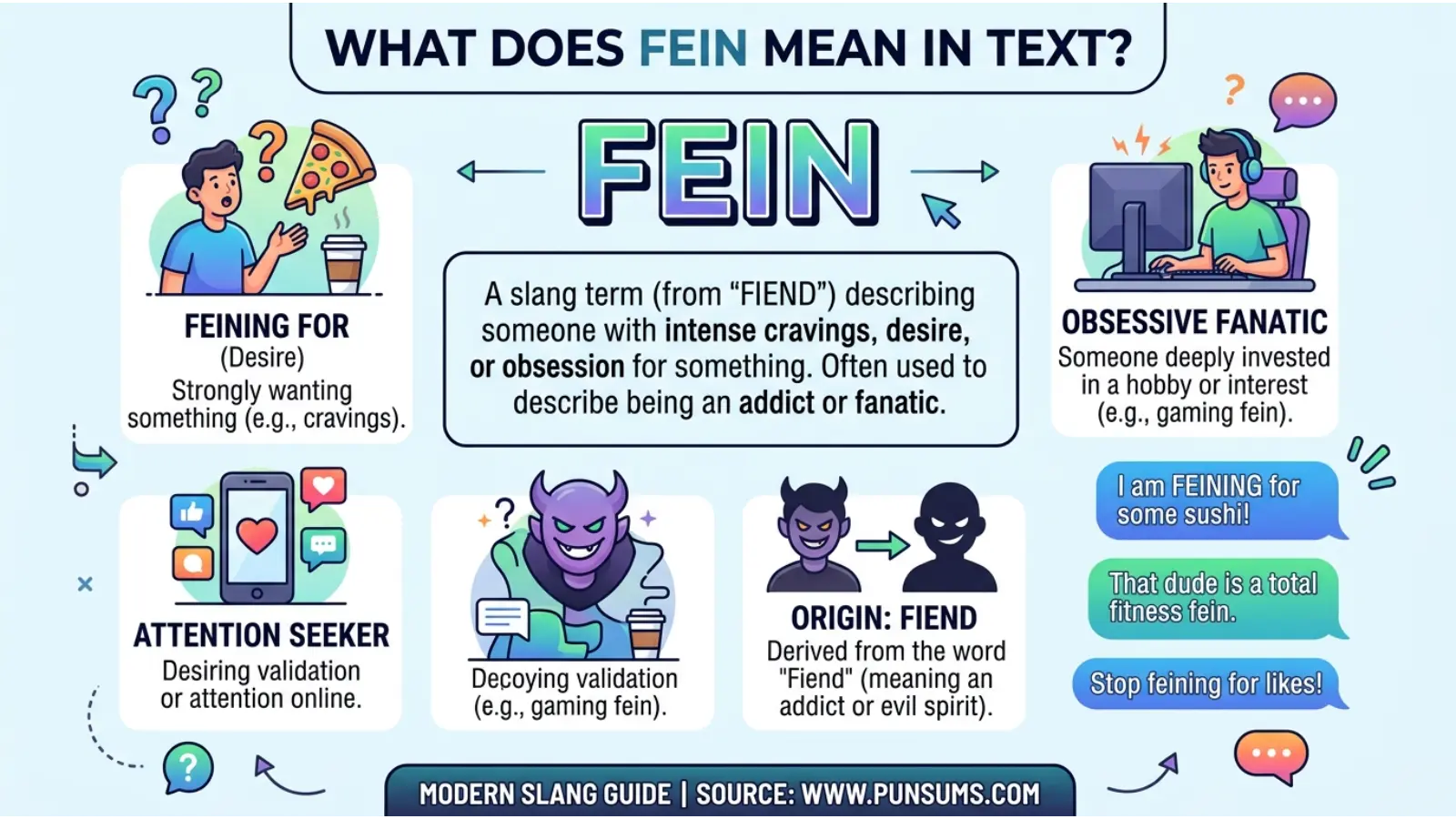
In modern slang, FEIN is often used to describe someone who is extremely obsessed with, excited about, or craving something.
Depending on the context, it can be playful, funny, teasing, or even a way to call out someone’s intense obsession.
Let’s explore what FEIN means, where it came from, and how people use it online today.
FEIN Meaning in Text – Quick Definition
In modern texting and internet slang, FEIN usually means:
Someone who is extremely obsessed with, addicted to, desperate for, or constantly wanting something.
The word is commonly used as a shortened slang variation of “fiend.”
People often use it jokingly to describe someone who can’t stop thinking about something.
Examples:
• “He’s a FEIN for video games.”
• “You’re FEINing for attention today.”
• “TikTok users became FEINs for that trend.”
• “She’s a coffee FEIN.”
Depending on context, FEIN can mean:
• Being obsessed with something.
• Wanting something badly.
• Craving attention.
• Chasing excitement.
• Loving something excessively.
• Playfully calling out someone’s behavior.
• Joking with friends.
• Teasing someone about an addiction or habit.
• Describing intense fandom.
• Expressing strong enthusiasm.
At its core, FEIN is all about desire.
It signals that someone wants something so much that other people have started noticing.
All Possible Meanings of FEIN in Text
The beauty of internet slang is that one word can carry multiple emotional meanings.
Here are the most common interpretations.
1. Obsession
The most popular meaning.
Example:
“Bro is a FEIN for sneakers.”
Translation:
He is obsessed with sneakers.
2. Addiction
Used jokingly for habits.
Example:
“You’re a FEIN for energy drinks.”
Translation:
You consume them constantly.
3. Extreme Fan
Example:
“She’s a Taylor Swift FEIN.”
Translation:
She loves everything related to that artist.
4. Craving Something
Example:
“I’m FEINing for pizza right now.”
Translation:
I really want pizza.
5. Attention Seeking
Example:
“Stop FEINing for attention.”
Translation:
Stop trying so hard to get people to notice you.
6. Relationship Obsession
Example:
“He’s FEINing over his crush.”
Translation:
He cannot stop thinking about them.
7. Social Media Addiction
Example:
“Everyone became FEINs for that trend.”
Translation:
People became obsessed with the trend.
8. Meme Expression
Sometimes FEIN is used simply because it’s funny.
The actual meaning becomes less important than the joke itself.
9. Excitement
Example:
“I’m FEINing for the weekend.”
Translation:
I’m extremely excited for it.
10. Emotional Attachment
Example:
“She’s FEINing over old memories.”
Translation:
She is emotionally attached to those memories.
Origin and Background of FEIN
The slang FEIN comes from the older English word “fiend.”
Historically, a fiend referred to an evil spirit or demon.
Over time, the meaning evolved.
In street slang and popular culture, fiend began describing someone addicted to something.
Examples included:
• Drug fiend.
• Gambling fiend.
• Attention fiend.
• Music fiend.
As internet culture grew, younger users started simplifying spellings.
Fiend gradually became FEIN in texts, comments, memes, captions, and social media posts.
Then TikTok arrived.
TikTok accelerated slang evolution faster than almost any platform before it.
A word that once belonged to specific communities suddenly became global overnight.
Memes, viral sounds, reaction videos, gaming communities, and music fandoms helped FEIN spread across the internet.
Today, millions of people use FEIN without even knowing its original spelling was “fiend.”
That’s how internet language works.
Words don’t just change.
They evolve with the communities using them.
Real-Life Conversations
WhatsApp Chat
Friend 1:
“How many times did you watch that movie?”
Friend 2:
“Seven.”
Friend 1:
“You’re a FEIN 😭”
Instagram DM
Person A:
“Another gym selfie?”
Person B:
“What’s wrong with that?”
Person A:
“You’re FEINing for gains.”
TikTok Comment
Creator:
“I bought my fifth Stanley cup.”
Comment:
“Stanley FEIN detected.”
Text Message
Friend:
“You already finished the whole season?”
Reply:
“Yeah.”
Friend:
“Netflix FEIN behavior.”
Group Chat
Person:
“I ordered bubble tea again.”
Reply:
“Certified bubble tea FEIN.”
The emotional pattern is easy to spot.
FEIN usually appears when someone repeatedly shows interest, excitement, or obsession toward something.
It’s often playful rather than mean.
Emotional and Psychological Meaning
This is where FEIN becomes more interesting.
Most slang words communicate more than their dictionary meaning.
They communicate emotions.
When someone calls another person a FEIN, they are often highlighting visible desire.
Humans naturally notice repeated behavior.
When we see someone constantly talking about one thing, buying one thing, posting one thing, or chasing one thing, our brains label that behavior.
FEIN is one of those labels.
Sometimes it’s teasing.
Sometimes it’s admiration.
Sometimes it’s a subtle way of saying:
“Wow, you really care about this.”
Imagine a friend who talks about a new relationship every day.
Eventually someone jokes:
“You’re FEINing over them.”
The joke works because everyone notices the emotional investment.
The word becomes social shorthand for obsession.
That’s the deeper psychology behind it.
Usage in Different Contexts
Social Media
FEIN is extremely common on TikTok, Instagram, Snapchat, and X.
Example:
“Everyone is FEINing for this trend.”
Meaning:
People are obsessed with it.
Friends and Relationships
Friends use FEIN playfully.
Example:
“You’re FEINing over your crush.”
The tone is usually teasing.
Work or Professional Settings
Generally avoid using FEIN in professional communication.
Some coworkers may not understand the slang.
Casual vs Serious Tone
Casual:
“He’s a FEIN for sneakers.”
Serious:
“He’s struggling with an unhealthy obsession.”
The same idea can carry very different emotional weight depending on context.
Context protects meaning.
Common Misunderstandings
FEIN Always Means Drugs
False.
While fiend historically had addiction-related meanings, modern FEIN often refers to harmless obsessions.
FEIN Is Always Insulting
Not true.
Many people use it affectionately.
FEIN Means Fan
Not exactly.
A fan enjoys something.
A FEIN is portrayed as being obsessed with it.
FEIN Has One Fixed Meaning
Internet slang rarely works that way.
Meaning changes with context.
Comparison Table
| Expression | Meaning | Tone | Usage Context |
|---|---|---|---|
| FEIN | Obsessed or craving | Playful | Social media |
| Fan | Likes something | Positive | General |
| Stan | Extremely dedicated fan | Intense | Online culture |
| Addicted | Cannot stop doing something | Serious or joking | Everyday speech |
| Simp | Excessive romantic attention | Humorous | Dating culture |
| Glazer | Overly praises someone | Mocking | Internet slang |
The emotional difference is subtle.
FEIN focuses more on craving and obsession than simple admiration.
Variations and Types
FEINing
Actively craving something.
Example:
“I’m FEINing for tacos.”
Certified FEIN
Someone universally recognized as obsessed.
Mega FEIN
Exaggerated meme version.
FEIN Mode
Acting obsessed at the moment.
Ultimate FEIN
Extreme internet humor version.
These variations add humor while keeping the same core idea of desire and obsession.
How to Respond When Someone Uses FEIN
Casual Replies
• “Maybe a little.”
• “You got me.”
• “Fair enough.”
Funny Replies
• “Proud FEIN.”
• “Caught in 4K.”
• “No regrets.”
Mature Replies
• “I just really enjoy it.”
• “It’s one of my favorite hobbies.”
Respectful Replies
• “That’s fair.”
• “I can see why you’d think that.”
Matching energy matters socially.
A playful comment deserves a playful response.
Regional and Cultural Usage
Western Culture
Used heavily in TikTok, gaming, and meme communities.
Asian Culture
Popular among younger users exposed to global internet trends.
Middle Eastern Culture
Often appears in English-speaking online communities.
Global Internet Usage
Social media removes borders.
A slang term can spread worldwide within days.
Generational Differences
Gen Z
Uses FEIN naturally in daily conversations.
Millennials
Usually understand it but may use it less frequently.
Older Generations
May interpret it literally or not recognize it at all.
Language often reflects digital identity.
The slang we use signals the communities we belong to.

Is FEIN Safe for Kids?
Generally yes.
Most uses are harmless and playful.
However, context still matters.
Children may use it teasingly, and excessive teasing can become uncomfortable.
Parents should focus on tone rather than the word itself.
In most situations, FEIN is simply modern internet slang.
FAQs
What does FEIN mean in texting?
It usually means someone is obsessed with, craving, or constantly wanting something.
Is FEIN an insult?
Not necessarily. Most people use it jokingly.
What does FEIN mean on TikTok?
It often describes someone obsessed with a trend, creator, song, or topic.
Can FEIN be positive?
Yes. It can describe enthusiasm and excitement.
Do Gen Z users commonly say FEIN?
Absolutely. It is heavily used across Gen Z internet culture.
Should I use FEIN at work?
Generally no. Professional communication is usually better without slang.
Conclusion
So, what does FEIN meaning in text really come down to?
At its heart, FEIN means someone who is obsessed with, craving, addicted to, excited about, or constantly wanting something.
The exact meaning changes depending on context, tone, and relationship.
Sometimes it’s a joke.
Sometimes it’s teasing.
Sometimes it’s a compliment.
And sometimes it’s simply internet culture finding a faster, funnier way to describe human desire.
That’s why FEIN became so popular.
Modern slang isn’t just about words.
It’s about emotions, identity, belonging, and the small signals people send online every day.
The next time someone calls you a FEIN, don’t just look at the word.
Look at the feeling behind it.
Because in today’s internet culture, FEIN is really a playful way of saying:
“You care about that a lot more than you’re admitting.”
Read More Posts:

I’m Miles Mirth, a humor-loving writer with a passion for clever puns and cheerful wordplay. I find joy in crafting lines that make people grin, giggle, and groan in delight. For me, laughter is life’s brightest spark, and I love sharing it through my writing. Every pun I create is a little dose of happiness meant to brighten your day.