POS Meaning slang is one of those internet terms that people often see in chats, social media comments, or even gaming conversations and immediately wonder what it means.
Because slang changes quickly online, abbreviations like POS can be confusing, especially for beginners or non-native English speakers.
Most of the time, POS is used as an insult in casual texting or online arguments, but it can also have harmless meanings depending on the context. That’s why understanding the tone and situation is very important before reacting to it.
People search for this slang because it appears in comments, memes, and messages where the meaning is not always obvious. Misunderstanding it can lead to confusion or even unnecessary conflict online.
Quick Answer:
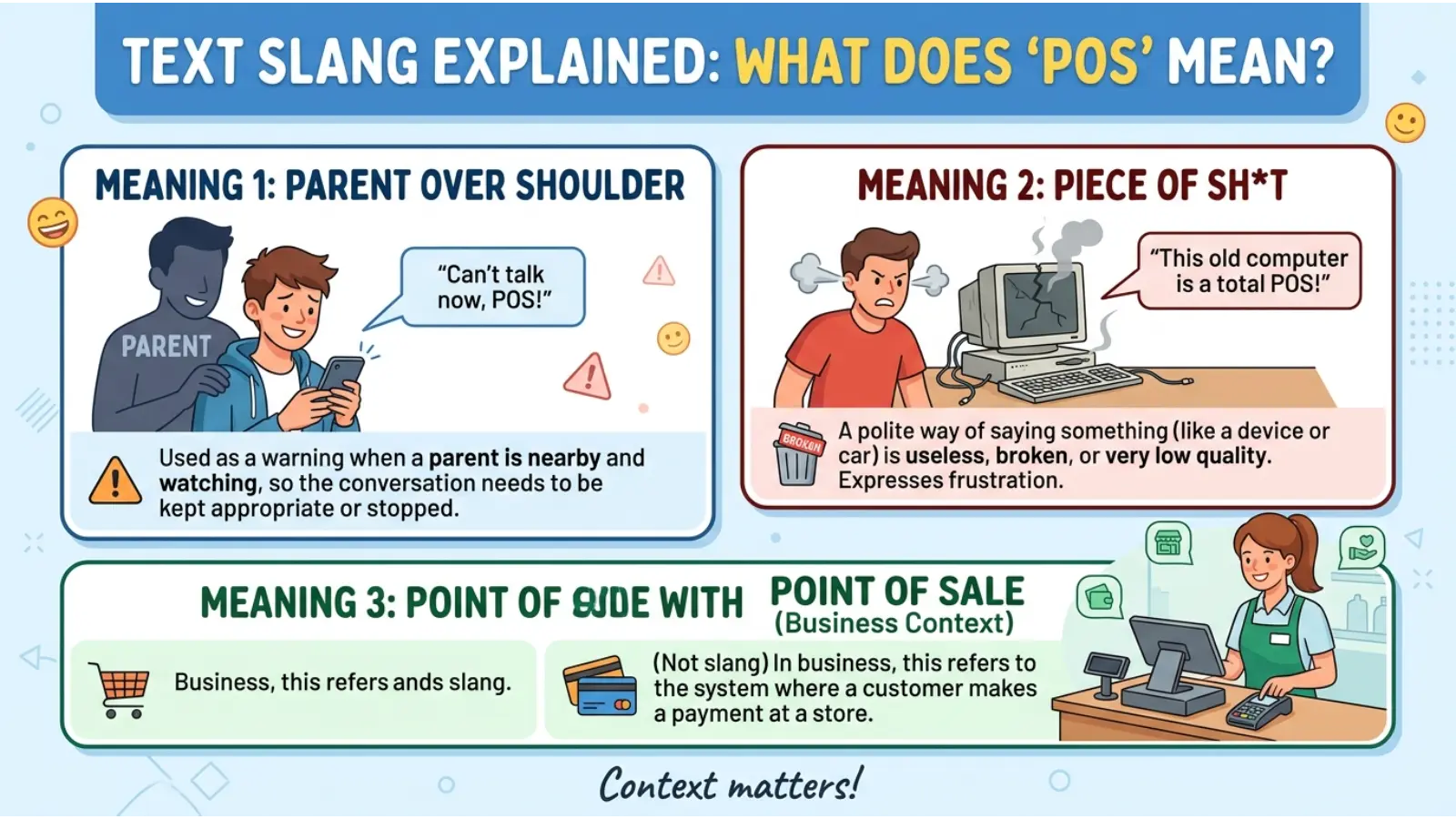
POS usually stands for “Piece of Sh*t” in slang, used as an insult to express anger or dislike toward someone or something.
What does POS meaning slang mean in text?
In modern internet slang, POS is commonly used as an abbreviation for a harsh insult. It stands for:
- Piece of Sh*t (offensive slang)
It is used to express strong frustration, anger, or disrespect toward a person or behavior. However, tone matters a lot—sometimes it is used jokingly among close friends, but often it is meant as an insult.
In rare contexts, POS can also mean:
- Point of Sale (in business/retail systems)
- Parent Over Shoulder (older internet chat slang)
But in most social media conversations, the slang meaning (insult) is the most common.
Full form / definition of POS slang
The main slang definition is:
POS = Piece of Sh*t
This is a rude expression used to criticize someone’s actions or behavior in a very negative way.
Other less common meanings include:
- Point of Sale (cash register systems in stores)
- Parent Over Shoulder (used in older chat rooms to warn privacy)
However, context usually makes it clear which meaning is intended.
Meaning in Different Contexts
The meaning of POS changes depending on where and how it is used:
1. Online arguments
Used as an insult:
- “He is a POS for doing that.”
2. Casual joking (friends)
Sometimes used jokingly:
- “You forgot my coffee again, you POS 😂”
3. Business context
Completely different meaning:
- POS system = cash register or payment system in shops
4. Gaming chats
Used as toxic slang:
- “That player is a POS camper.”
👉 Always check tone and situation before interpreting it.
Is POS rude, offensive, or neutral?
POS is generally considered:
- ❌ Offensive in most cases
- ⚠️ Semi-joking among friends (rare)
- ✅ Neutral only in business meaning (Point of Sale)
Because it contains a swear word, it is not appropriate in formal or professional communication.
Where is POS commonly used?
You will mostly see POS in:
- Social media platforms (Facebook, Instagram, TikTok comments)
- Online gaming chats (PUBG, Fortnite, etc.)
- Messaging apps (WhatsApp, Discord, Snapchat)
- Meme culture and internet jokes
It is rarely used in professional writing unless referring to “Point of Sale.”
Real-life conversation examples
1.Friendly (joking tone)
- A: “You ate my fries again!”
- B: “Oops, you POS 😂”
2.Casual online chat
- “That driver is a POS for blocking the road like that.”
3.Argumentative tone
- “Don’t talk to me like that, you POS!”
4.Gaming context
- “This POS lag ruined my match.”
Emotional and Psychological Meaning
When someone uses POS in conversation, it often reflects:
- Anger or frustration
- Disappointment
- Disrespect toward behavior
- Emotional reaction during conflict
People rarely use it calmly. Most often, they type it during heated moments when emotions run high.
Origin and background of the slang
The phrase “piece of sh*t” has been used in English for decades as a strong insult. With the rise of internet messaging and texting, people started shortening it to POS for quick typing.
It became popular in:
- Early internet chat rooms
- Online gaming communities
- Social media comment sections
Over time, it became part of modern digital slang.
Comparison with similar slang
| Slang | Full Form | Meaning | Tone |
|---|---|---|---|
| POS | Piece of Sh*t | Very strong insult | Very offensive |
| SOB | Son of a B*tch | Insult or anger | Offensive |
| Jerk | — | Mild insult | Less offensive |
| Idiot | — | Calling someone stupid | Mild |
👉 POS is stronger and more offensive than most common insults.
When to avoid using POS
You should avoid using POS in:
- Professional emails or workplace chats
- Formal discussions
- Talking to strangers or elders
- Academic writing
- Customer service communication
Better situations to avoid it:
- Job interviews
- School assignments
- Public social media posts (if you want a clean profile)
Polite alternatives
If you want to express frustration without being offensive, you can use:
- “That was not nice”
- “I’m really disappointed”
- “That behavior is unacceptable”
- “That was unfair”
- “I don’t agree with that”
These alternatives help you stay respectful while still expressing emotion.
Why people use POS slang
People use POS because:
- It is short and quick to type
- It expresses strong emotions instantly
- It is common in online culture
- It feels more impactful in arguments
- It is widely understood in internet communities
However, it can also escalate conflicts quickly.
Impact of using POS in communication
Using POS can have both positive and negative effects:
Negative impact:
- Can hurt feelings
- May cause online arguments
- Seen as toxic behavior
- Damages reputation if used publicly
Positive (rare cases):
- Expresses strong emotion quickly
- Used humorously among close friends
Is POS safe for social media?
POS is not fully safe for public social media use because:
- It contains offensive language
- It can be reported or flagged
- It may affect your online image
People still commonly use it in informal conversations, especially in private chats or gaming.
Common misunderstandings
Many people confuse POS with:
- “Point of Sale” (business meaning)
- “Parent Over Shoulder” (old chat slang)
Because of this, context is extremely important. Without context, POS can be misunderstood easily.
Variations and types of POS usage
- POS (text abbreviation)
- “You POS” (direct insult)
- “That POS” (referring to object/person)
- POS system (business meaning – completely different usage)
How to respond when someone uses POS
If someone calls you POS:
- Stay calm and avoid reacting emotionally
- Ask for clarification if needed
- Ignore if it’s trolling
- Block or report if it becomes harassment
Example response:
- “Let’s keep the conversation respectful.”
Regional and cultural usage
POS is mostly used in:
- USA and UK internet slang
- Global gaming communities
- Social media worldwide
Many people in non-English-speaking countries often use POS without fully understanding its intensity.
FAQs about POS Meaning slang
1. What does POS mean in slang?
POS usually means “Piece of Sh*t,” used as an insult online.
2. Is POS a bad word?
Yes, it is considered offensive in most contexts.
3. Can POS mean something positive?
No, except in business where it means “Point of Sale.”
4. Why do people use POS in chats?
To express strong anger or frustration quickly.
5. Is POS safe to use on social media?
Not really, it can be seen as rude or toxic.
6. What is POS full form in texting?
In slang texting, it stands for “Piece of Sh*t.”
Conclusion
People widely use POS slang across social media, gaming, and texting platforms, making it important to understand its meaning. While it mainly stands for a strong insult (“Piece of Sh*t”), its meaning can change depending on context. Use this slang carefully because it can easily come across as offensive or disrespectful. In professional or public communication, it is always better to use polite alternatives.
In short, POS is a powerful internet slang term that reflects strong emotion, but context and tone decide whether it is acceptable or not.