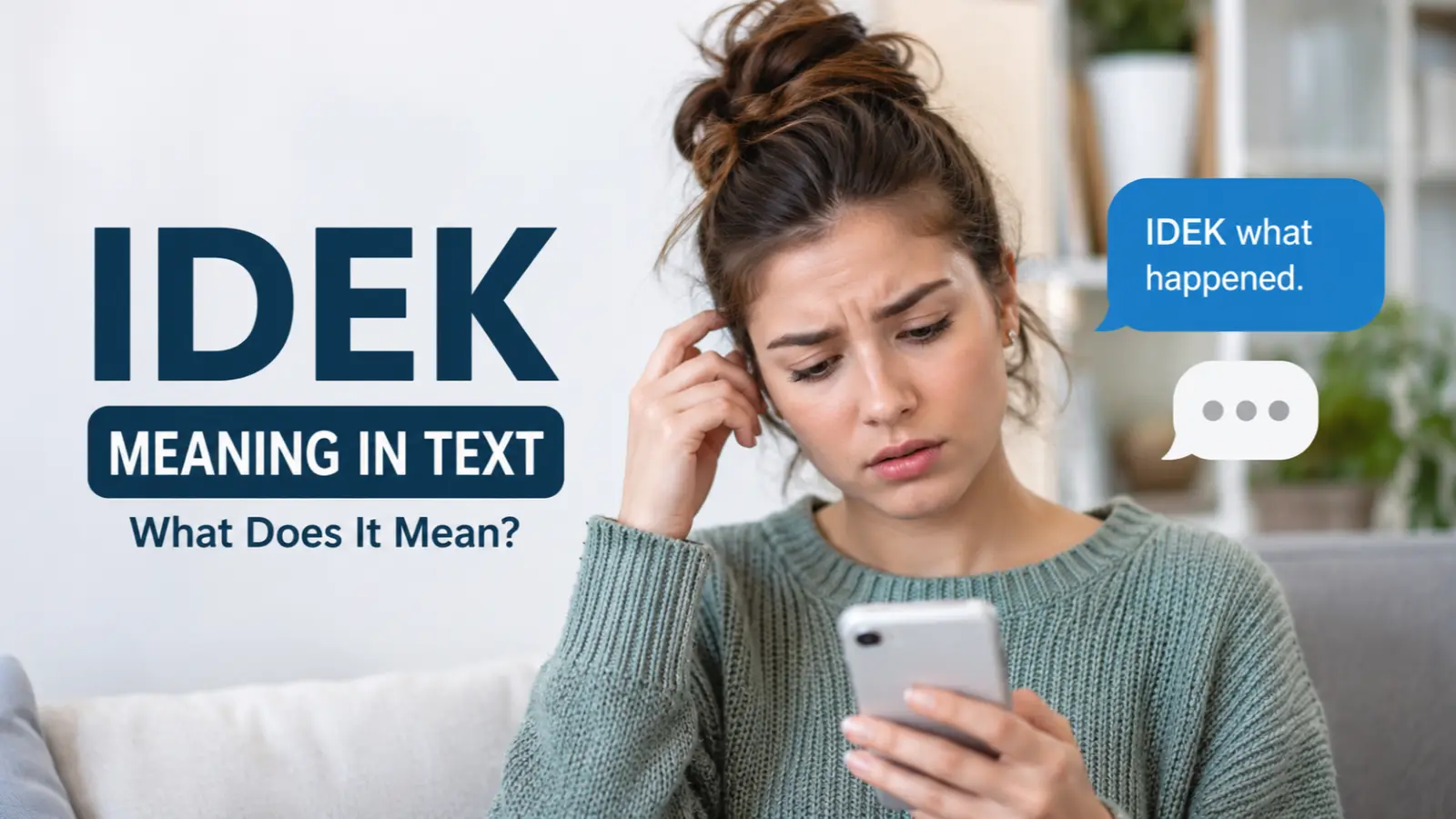
idek meaning in text is a common question people ask after seeing the abbreviation in messages, social media comments, or online conversations.
Internet slang changes quickly, and new abbreviations appear all the time. If someone sends you “idek” in a text message, you might feel confused if you’ve never seen it before.
Today, IDEK is widely used on platforms like Instagram, Snapchat, TikTok, WhatsApp, Facebook, X (Twitter), and texting apps. It helps people express uncertainty, confusion, surprise, or a lack of knowledge in a quick and casual way.
Understanding modern slang can help you communicate better online and avoid misunderstandings. In this guide, you’ll learn the full meaning of IDEK, its origin, examples, proper usage, and how to respond when someone uses it.
Quick Answer
IDEK stands for “I Don’t Even Know.” It is commonly used in texting and social media when someone feels confused, unsure, surprised, or doesn’t have an answer.
What Does IDEK Mean in Text?
The idek meaning in text is “I Don’t Even Know.”
People use it when they:
- Don’t know the answer to something
- Feel confused
- Are surprised by a situation
- Cannot explain something
- Feel overwhelmed or frustrated
It is an informal abbreviation commonly used in casual online conversations.
Example
Friend: Why is everyone talking about that video?
You: IDEK, I haven’t seen it yet.
In this example, IDEK simply means “I don’t even know.”
IDEK Full Form
The IDEK full form is:
I = I
D = Don’t
E = Even
K = Know
So when someone types IDEK, they are shortening the phrase “I Don’t Even Know” to save time while texting.
What Does IDEK Stand For?
If you’re wondering what does IDEK stand for, the answer is straightforward:
IDEK = I Don’t Even Know
The phrase often adds extra emphasis compared to simply saying “I don’t know.”
Example
I don’t know = Normal uncertainty
I don’t even know = Stronger uncertainty or confusion
Meaning of IDEK in Different Contexts
The meaning of IDEK can vary slightly depending on the situation.
1. Confusion
Someone may use IDEK when they are confused.
Example:
“IDEK how this happened.”
Meaning: The person genuinely doesn’t understand what happened.
2. Frustration
People often use it when they are frustrated.
Example:
“IDEK why I keep making the same mistake.”
Meaning: The speaker feels annoyed and confused.
3. Surprise
Sometimes IDEK expresses shock.
Example:
“IDEK what to say after hearing that.”
Meaning: The news was surprising.
4. Lack of Knowledge
It can simply mean the person doesn’t know something.
Example:
“IDEK where he lives.”
Meaning: The speaker doesn’t have that information.
Is IDEK Rude, Offensive, or Neutral?
IDEK is generally considered neutral and harmless slang.
Usually Neutral
- Casual conversations
- Text messages
- Social media comments
- Chats with friends
Can Sound Dismissive Sometimes
Depending on tone, it might appear uninterested.
Example:
Person: Why are you ignoring me?
Reply: IDEK.
This could seem rude because it doesn’t provide much explanation.
Overall
IDEK is not offensive, but context matters.
Where Is IDEK Commonly Used?
IDEK is popular across many digital platforms.
Social Media
- TikTok
- X (Twitter)
- Threads
Messaging Apps
- Messenger
- Telegram
- Snapchat
- Discord
Online Communities
- Gaming chats
- Group conversations
- Forums
Young people and frequent internet users tend to use IDEK more often than older generations.
Emotional and Psychological Meaning of IDEK
Beyond its literal definition, IDEK often reflects emotions.
It May Indicate:
- Confusion
- Stress
- Mental overload
- Frustration
- Surprise
- Emotional uncertainty
For example:
“IDEK what I’m doing anymore.”
This statement may suggest deeper frustration rather than simply lacking information.
The emotional tone depends heavily on the conversation.
Origin and Background of IDEK
IDEK emerged as part of internet and texting culture.
As mobile texting became more popular, people started shortening common phrases to save time.
Similar abbreviations appeared, including:
- IDK (I Don’t Know)
- IDC (I Don’t Care)
- IMO (In My Opinion)
- TBH (To Be Honest)
Eventually, IDEK gained popularity because it adds more emotion and emphasis than IDK.
Today, it is widely recognized across social media and online communication.
Comparison With Similar Slang
The following table compares IDEK with similar internet abbreviations.
| Slang | Full Form | Meaning | Tone |
|---|---|---|---|
| IDEK | I Don’t Even Know | Strong confusion or uncertainty | Casual |
| IDK | I Don’t Know | Basic uncertainty | Neutral |
| IDC | I Don’t Care | Lack of interest | Dismissive |
| TBH | To Be Honest | Honest opinion | Friendly |
| IMO | In My Opinion | Personal viewpoint | Neutral |
| SMH | Shaking My Head | Disappointment | Critical |
IDEK vs IDK
Many people confuse these terms.
IDK = Simple lack of knowledge
IDEK = Stronger confusion, surprise, or uncertainty
Why People Use IDEK
There are several reasons people choose IDEK instead of writing the full phrase.
Convenience
Typing four letters is faster than typing four words.
Emotional Expression
It emphasizes confusion more effectively.
Internet Culture
Using slang helps people communicate naturally online.
Casual Communication
IDEK fits informal conversations better than formal language.
Real-Life Conversation Examples
Friendly Example
Friend: What movie should we watch tonight?
You: IDEK, you choose.
Casual Example
Person: Why is the app not working?
Reply: IDEK, mine keeps crashing too.
Argumentative Example
Person: Why did you do that?
Reply: IDEK anymore.
School Context
Student: When is the assignment due?
Friend: IDEK, ask the teacher.
Workplace Context
Coworker: Why is the system down?
Employee: IDEK, IT is checking it.
Common Misunderstandings About IDEK
Misunderstanding #1
People think IDEK means exactly the same thing as IDK.
Reality: IDEK usually shows stronger confusion.
Misunderstanding #2
Some believe it is rude.
Reality: It is generally neutral and casual.
Misunderstanding #3
People assume it is only for teenagers.
Reality: Anyone who uses online communication may use it.
Variations and Related Terms
Several slang terms are related to IDEK.
IDK
I Don’t Know
IDC
I Don’t Care
IKR
I Know, Right?
TBH
To Be Honest
NGL
Not Gonna Lie
SMH
Shaking My Head
These abbreviations frequently appear together in social media conversations.
When to Use IDEK
IDEK works best in informal situations.
Good Times to Use It
- Texting friends
- Social media comments
- Casual group chats
- Online gaming conversations
Example
“IDEK what happened today.”
When to Avoid Using IDEK
Avoid IDEK in professional communication.
Not Recommended For
- Job applications
- Business emails
- Academic papers
- Formal reports
- Professional presentations
Better Alternative
Instead of:
“IDEK the answer.”
Use:
“I am not sure of the answer.”
Polite Alternatives to IDEK
When you need a more professional tone, consider these alternatives:
- I’m not sure.
- I don’t know.
- I need to check.
- Let me find out.
- I don’t have that information yet.
- I’ll look into it.
These phrases sound more appropriate in formal settings.
Impact of Using Slang in Communication
Slang like IDEK can make communication:
More Personal
It creates a friendly atmosphere.
Faster
Messages become shorter and quicker to type.
More Relatable
People often connect through shared online language.
However, excessive slang can sometimes cause confusion, especially across different age groups or cultures.
Is IDEK Safe for Social Media?
Yes, IDEK is generally safe for social media use.
It is:
- Non-offensive
- Commonly understood
- Family-friendly
- Widely accepted online
Just remember that not everyone may know internet slang, so consider your audience.
How to Respond When Someone Uses IDEK
Your response depends on the context.
If They Are Confused
“Let’s figure it out together.”
If They Don’t Know Something
“No worries, I’ll ask someone else.”
If They’re Frustrated
“I understand. It sounds confusing.”
If They’re Surprised
“Yeah, I was shocked too.”
Understanding the situation helps you respond appropriately.
Regional and Cultural Usage
IDEK is most common in:
- United States
- Canada
- United Kingdom
- Australia
- Online English-speaking communities
Because of social media, it is increasingly recognized worldwide.
Even non-native English speakers frequently use IDEK in online conversations.
FAQs
What does IDEK mean in text?
IDEK means “I Don’t Even Know.” It expresses confusion, uncertainty, or surprise.
Is IDEK the same as IDK?
No. IDK means “I Don’t Know,” while IDEK adds stronger emphasis and emotion.
Is IDEK rude?
Generally, no. It is a neutral slang term, though context can affect how it sounds.
Can I use IDEK in professional emails?
It is better to avoid IDEK in formal or professional communication.
Is IDEK popular on social media?
Yes. It is widely used on TikTok, Instagram, Snapchat, X, and messaging apps.
What is the IDEK meaning slang?
In slang, IDEK means “I Don’t Even Know” and is used to show confusion or uncertainty.
Conclusion
Understanding the idek meaning in text is simple once you know its full form. IDEK stands for “I Don’t Even Know“ and is commonly used to express confusion, uncertainty, frustration, or surprise in online conversations.
The slang is casual, widely accepted, and popular across social media platforms and texting apps. While it’s perfectly fine for informal communication, it should generally be avoided in professional or academic settings.
By understanding IDEK full form, IDEK meaning slang, and what does IDEK stand for, you can confidently use and recognize this abbreviation in everyday digital communication. Always consider the context and tone to ensure your message is understood correctly.
Read More Posts:

I’m Luna Punster, a wordplay enthusiast who loves turning ordinary phrases into pun-tastic creations. I believe laughter is the best kind of connection, and puns make it even better. Writing witty and clever lines is my favorite way to spark smiles.
Through my playful words, I aim to sprinkle joy and humor everywhere I go.