MK meaning in text is a common search because many people notice the abbreviation in text messages, online chats, gaming conversations, and social media posts.
If someone replies with “MK,” you may wonder whether they are agreeing with you, ending the conversation, or using a different slang term altogether.
Internet slang changes quickly, and short abbreviations like MK help people type faster while keeping conversations casual.
Depending on the situation, MK can have slightly different meanings, but in most everyday conversations, it has one simple interpretation.
If you’re chatting with friends, texting a family member, or reading comments on social media, understanding what MK means can help you avoid confusion and respond naturally.
Quick Answer
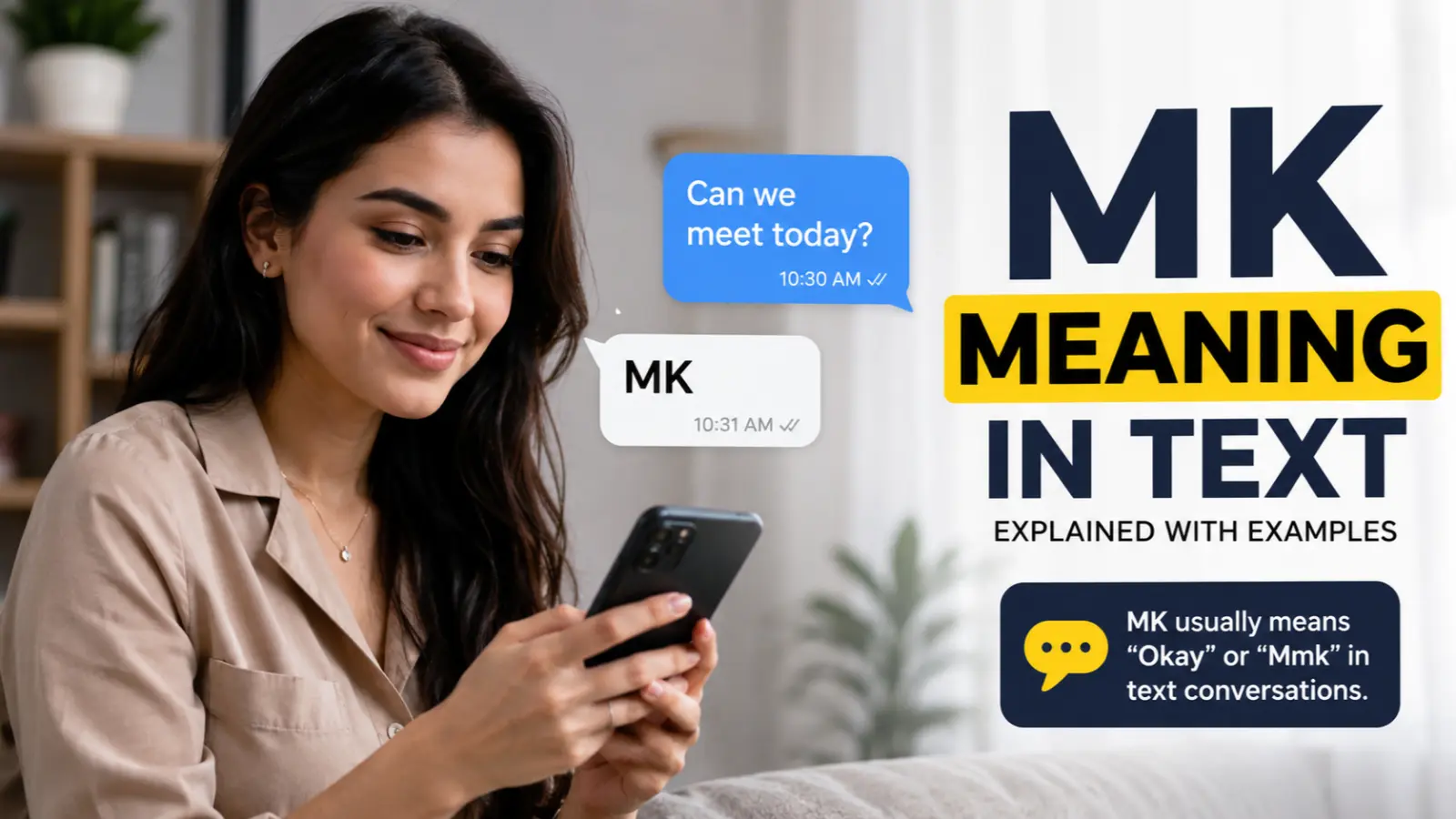
MK usually means “Mmk” or “Okay.” It is an informal way of saying “OK,” “Alright,” “I understand,” or “I agree.” The exact tone depends on the conversation and the sender’s intent.
What Does MK Mean in Text?
The MK meaning in text is most commonly an informal version of “OK.” People use it to acknowledge a message without typing a longer response.
Instead of writing:
- Okay
- OK
- Alright
They simply type:
- MK
It is short, quick, and commonly used in casual conversations.
For example:
Friend: “I’ll call you after work.”
You: “MK.”
Here, MK simply means “Okay, sounds good.”
MK Full Form
Unlike some internet abbreviations, MK does not have one official full form in casual texting.
Here are the most common meanings:
| MK | Meaning | Usage |
|---|---|---|
| MK | Okay | Most common meaning |
| MK | Mmk | Casual agreement |
| MK | Message received | Informal acknowledgment |
| MK | Mark | Rare abbreviation depending on context |
What Does MK Stand For?
If you’re asking “What does MK stand for?”, the answer depends on the conversation.
Most of the time, it simply stands for:
- Okay
- Mmk
- I understand
- Got it
In non-texting situations, MK can also represent initials, product names, companies, or other abbreviations. However, in everyday messaging, it almost always means “Okay.”
MK Meaning in Different Contexts
The meaning of MK can change slightly depending on where it is used.
1. Casual Text Messages
Friends often use MK as a quick acknowledgment.
Example:
Sarah: “Meet me at 7.”
John: “MK.”
Meaning:
“I’ll be there.”
2. Social Media
On platforms like Instagram, Snapchat, TikTok, Facebook, or X, MK is often used in comments or direct messages to show agreement.
Example:
“MK, I’ll check it later.”
Meaning:
“Okay, I’ll do that.”
3. Online Gaming
Gamers use MK because they need fast communication.
Example:
“MK, let’s start.”
Meaning:
“I’m ready.”
4. Group Chats
In group conversations, MK simply confirms that someone has seen and understood the message.
Example:
“MK everyone, see you tomorrow.”
Meaning:
“Okay, see you tomorrow.”
5. Workplace Chats
Some coworkers may use MK in informal team chats, although many prefer writing OK or Okay in professional communication.
Example:
“I’ll finish the report.”
Reply:
“MK.”
Meaning:
“I understand.”
Is MK Rude, Offensive, or Neutral?
Generally, MK is considered neutral. It is not offensive or inappropriate.
However, the tone depends on how it is used.
When MK Sounds Friendly
- Talking with friends
- Casual texting
- Family conversations
- Quick acknowledgments
Example:
“MK 😊”
This sounds warm and relaxed.
When MK May Sound Cold
Sometimes MK can seem short or uninterested if no other words are added.
Example:
Person A:
“I’m really excited!”
Person B:
“MK.”
Although it still means “Okay,” the reply may feel dismissive because it lacks emotion.
Adding emojis or extra words makes the tone friendlier.
For example:
- MK, sounds good!
- MK 👍
- MK lol
- MK, thanks!
Is MK Ever Offensive?
No.
Unlike some slang abbreviations, MK is not considered offensive. It does not contain rude language or insults.
The only misunderstanding comes from the tone. A very short reply may appear:
- Uninterested
- Annoyed
- Bored
- Impatient
Even though the abbreviation itself is harmless.
Where Is MK Commonly Used?
You will often see MK in places where people prefer short, fast replies.
Common platforms include:
- SMS text messages
- Messenger
- Instagram DMs
- Snapchat
- TikTok comments
- Discord
- Online gaming chats
- Facebook Messenger
- Telegram
It is especially popular among younger users who frequently use internet slang and abbreviations.
Common Situations Where People Use MK
People often send MK when they want to:
- Confirm they understand.
- Agree with someone’s plan.
- End a conversation politely.
- Respond quickly without typing a full sentence.
- Acknowledge a message.
- Keep a chat moving.
For example:
- “MK, see you later.”
- “MK, I’ll check it.”
- “MK, thanks.”
- “MK, sounds good.”
- “MK, no problem.”
These responses are short, natural, and commonly used in everyday digital communication.
Real-Life Conversation Examples
Understanding the MK meaning in text becomes easier when you see it used in real conversations. Here are examples showing different tones and situations.
1. Friendly Conversation
Emma: “Want to grab coffee after class?”
Liam: “MK! See you at 4.”
Meaning: Liam agrees enthusiastically.
2. Casual Chat
Friend: “I’ll send you the photos tonight.”
You: “MK.”
Meaning: A simple acknowledgment that means “Okay.”
3. Family Text
Mom: “Don’t forget to buy milk.”
You: “MK, I will.”
Meaning: You understand and agree.
4. Argumentative Conversation
Person A: “You never listen.”
Person B: “MK.”
Meaning: Here, “MK” may sound dismissive or unwilling to continue the discussion. The tone depends on the relationship and context.
5. Workplace Chat
Manager: “Please submit the report by 5 PM.”
Employee: “MK, I’ll send it before then.”
Meaning: Confirmation that the message has been received.
6. Gaming Chat
Teammate: “Let’s attack from the left side.”
Player: “MK.”
Meaning: Agreement with the plan.
Emotional and Psychological Meaning
Although MK simply means “Okay” in most conversations, it can communicate different emotions depending on how it is used.
Positive Tone
It may express:
- Agreement
- Understanding
- Cooperation
- Acceptance
Example:
“MK! Sounds like a great idea.”
Neutral Tone
Sometimes it simply acknowledges a message without adding emotion.
Example:
“MK.”
This is common when someone wants to reply quickly.
Negative Tone
In certain situations, MK may appear:
- Impatient
- Cold
- Uninterested
- Slightly annoyed
For example:
Person A: “Can we talk about what happened?”
Person B: “MK.”
The word itself isn’t rude, but the short response may feel emotionally distant.
Origin and Background of MK
The abbreviation MK developed naturally as texting became more popular. People began shortening common words to save time and type faster.
Many internet users started replacing “Okay” with “K.” Later, expressions like “Mmk” (a spoken version of “Okay”) became common in online conversations. Eventually, many people shortened it further to “MK.”
Today, it appears frequently in:
- Text messages
- Social media
- Online games
- Group chats
- Instant messaging apps
Unlike many internet abbreviations, MK has no single official origin. Instead, it evolved through everyday digital communication.
MK vs Similar Slang Terms
Many abbreviations have meanings similar to MK, but each has a slightly different tone.
| Slang | Meaning | Tone | Common Use |
|---|---|---|---|
| MK | Okay / Mmk | Neutral | Casual texting |
| OK | Okay | Neutral | Universal |
| K | Okay | Can sound cold | Very short replies |
| KK | Okay, got it | Friendly | Text messages |
| Got it | I understand | Professional | Work and school |
| Sure | I agree | Friendly | Everyday conversations |
| Alright | Okay | Relaxed | Casual speech |
Which One Should You Use?
- Use MK with friends and casual chats.
- Use OK almost anywhere.
- Use Got it in professional conversations.
- Use KK when you want to sound more friendly.
When to Use MK and When to Avoid It
Use MK When
- Chatting with friends
- Talking with siblings
- Replying in group chats
- Gaming online
- Sending quick confirmations
- Responding casually on social media
Avoid MK When
- Writing business emails
- Speaking with clients
- Academic writing
- Formal applications
- Professional reports
- Official workplace communication
In formal situations, writing “Okay,” “Understood,” or “I understand” creates a better impression.
Polite Alternatives to MK
If you prefer a more professional or friendly response, consider these alternatives:
- Okay
- Certainly
- Understood
- Sounds good
- Absolutely
- Will do
- Got it
- No problem
- I understand
- Sure
These options often sound warmer and more engaging than a simple “MK.”
Why People Use MK
People use MK because it is:
- Quick to type
- Easy to understand
- Common in texting culture
- Less formal than “Okay”
- Convenient during fast conversations
Short abbreviations like MK help keep conversations moving without requiring long replies.
Impact of Using Slang in Communication
Internet slang has changed how people communicate online.
Benefits
- Faster conversations
- Casual and friendly tone
- Easy mobile typing
- Builds familiarity among friends
Drawbacks
- Can confuse people unfamiliar with slang
- May sound rude if overused
- Not suitable for professional settings
- Meaning depends on context
Choosing the right tone for your audience is just as important as understanding the slang itself.
Is MK Safe for Social Media?
Yes. MK is generally safe to use on social media.
You can use it on platforms like:
- Snapchat
- TikTok
- X (formerly Twitter)
- Discord
- Telegram
Since it simply means “Okay” or “I understand,” it is not offensive or inappropriate.
Just remember that very short replies may sometimes seem less enthusiastic than longer responses.
Common Misunderstandings
People sometimes misunderstand MK because it can have different meanings outside of texting.
Some common misconceptions include:
- Thinking it has a hidden meaning.
- Assuming it is an insult.
- Believing it is always sarcastic.
- Confusing it with initials, company names, or product abbreviations.
In most personal text conversations, however, MK simply means “Okay.”
Variations and Types
Several similar abbreviations are used in digital communication.
- MK – Okay
- Mmk – Spoken version of “Okay”
- K – Short for “Okay”
- KK – Friendly confirmation
- Kk – Casual agreement
- Oki – Cute version of “Okay”
- Okie – Informal and cheerful response
All of these serve a similar purpose but may convey slightly different tones.
How to Respond When Someone Uses MK
If someone texts MK, your response depends on the conversation.
If They Are Agreeing
You can reply:
- Great!
- Thanks!
- Sounds good.
- See you then.
- Perfect!
If It Seems Dismissive
Consider asking politely:
- Is everything okay?
- Did you mean you’re okay with the plan?
- Let me know if you have any questions.
Avoid assuming the sender is upset based on a single short message.
Regional and Cultural Usage
The MK meaning in text is widely understood in English-speaking online communities.
It is especially common in:
- United States
- Canada
- United Kingdom
- Australia
- India
- Pakistan
- Philippines
- Other countries where English texting is popular
Because internet slang spreads quickly through social media, many users around the world recognize MK as another way of saying “Okay.”
Frequently Asked Questions (FAQs)
What does MK mean in text?
MK usually means “Okay” or “Mmk.” It is an informal way of showing agreement or acknowledging a message.
What is the MK full form?
In casual texting, MK does not have an official full form. It is simply a shortened form of “Okay” or “Mmk.”
Is MK rude in messages?
No. MK is generally neutral. However, because it is a very short reply, it may sometimes sound cold or uninterested depending on the context.
What does MK stand for in slang?
In internet slang, MK commonly stands for “Okay” or “Mmk,” indicating agreement or understanding.
Can I use MK in professional emails?
It is better not to. In formal communication, use complete responses such as “Okay,” “Understood,” or “I understand.”
Is MK the same as K?
Not exactly. Both can mean “Okay,” but MK often sounds slightly friendlier than a single “K,” which some people interpret as abrupt.
Conclusion
The MK meaning in text is simple yet useful to understand. In most conversations, MK means “Okay,” “Mmk,” or “I understand.” It is a quick, informal way to acknowledge a message, agree with someone, or keep a conversation moving.
While MK is safe and widely accepted in casual texting, social media, and online chats, it is best avoided in formal or professional communication where complete responses create a better impression.
As with most internet slang, context matters. A friendly conversation may make MK sound warm and natural, while a brief reply during a serious discussion could seem distant. Understanding the situation, tone, and relationship between the people chatting will help you use MK confidently and communicate more effectively.