Have you ever been scrolling through TikTok comments, reading a group chat, or checking Instagram replies when someone suddenly says, “She clocked it” or “You really clocked that”?
At first glance, it sounds like something related to time or a clock. But then the conversation keeps going, everyone seems to understand it, and you’re left wondering what exactly just happened.
Maybe you saw messages like:
“Wait… you clocked it.”
“He clocked her tea immediately.”
“Nobody clocked the shade.”
“She clocked that from a mile away.”
So what does “clock it” actually mean in text? Is it a compliment? An insult? A joke? A way of exposing someone?
The answer depends on context, tone, and internet culture.
As modern slang continues evolving across TikTok, Twitter, Instagram, and texting culture, phrases like “clock it” carry much more emotional meaning than their literal definitions.
Let’s break it down in a way that actually makes sense.
What Does Clock It Meaning in Text – Quick Definition
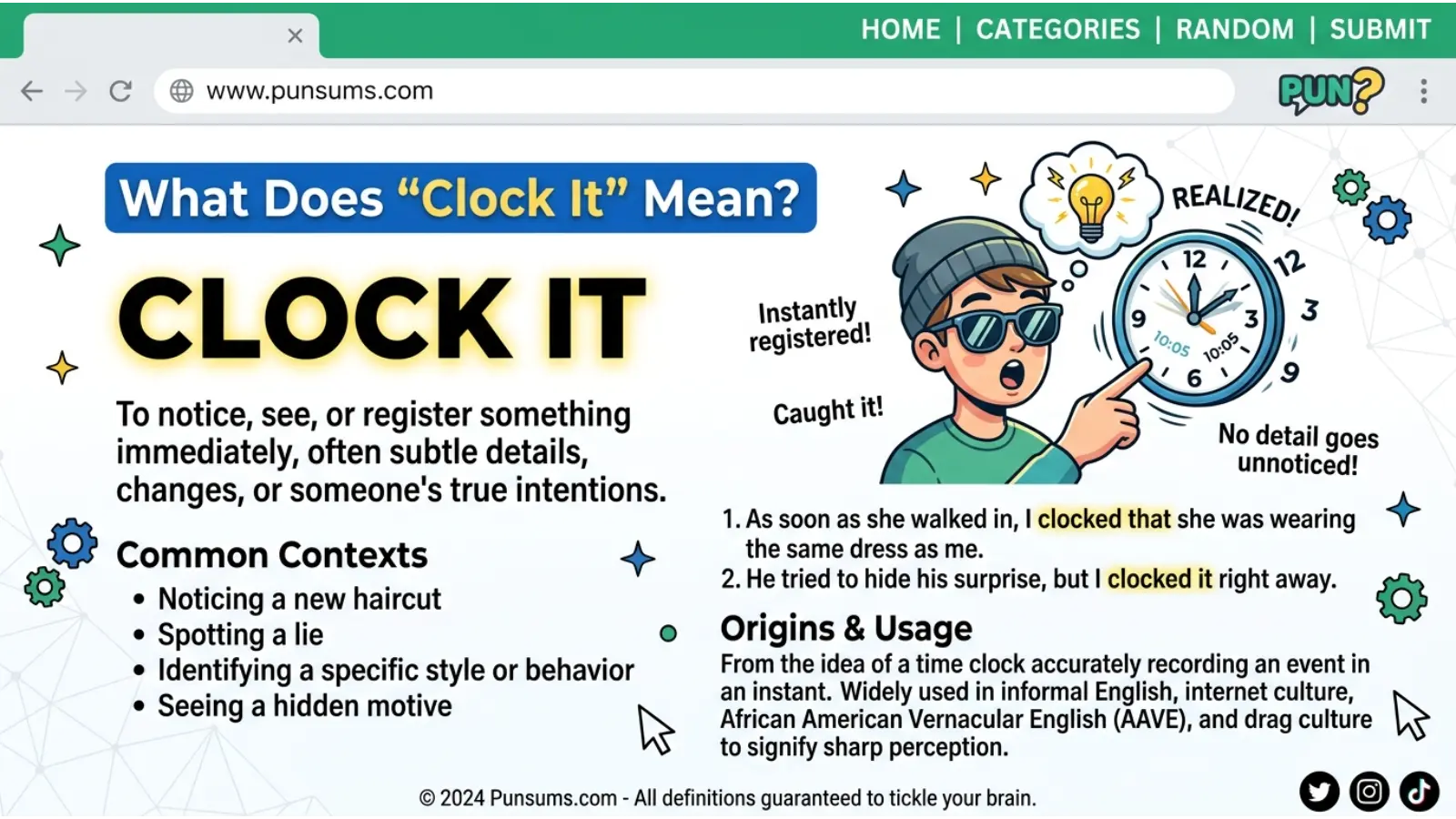
In texting, social media, and internet slang, “clock it” means:
- To notice something.
- To recognize something quickly.
- To point out a truth.
- To catch hidden behavior.
- To identify details others missed.
- To expose something.
- To accurately read a situation.
At its core, “clock it” means someone observed something correctly and understood what was really happening.
Examples:
“She clocked his fake attitude immediately.”
“Nobody clocked the joke except Sarah.”
“You clocked it perfectly.”
Depending on the tone, it can be used for:
- Noticing.
- Complimenting.
- Calling someone out.
- Joking.
- Flirting.
- Exposing behavior.
- Showing intelligence.
The emotional meaning is usually:
“I see what’s really going on.”
Origin and Background of Clock It
The phrase “clock” has existed for decades in various communities, particularly within Black and LGBTQ+ culture.
Historically, “to clock someone” meant to notice, identify, or recognize something about a person.
Over time, the phrase became common in drag culture, ballroom communities, and online spaces where social awareness and sharp observation were highly valued.
Then social media arrived.
Platforms like TikTok, Twitter, Instagram, and YouTube Shorts accelerated the spread of the phrase.
Users began commenting:
“Clock it.”
“You clocked that.”
“They clocked her tea.”
“Clocked.”
Soon the phrase evolved beyond its original communities and entered mainstream internet vocabulary.
Today, millions of people use it daily without realizing its cultural roots.
Online language evolves incredibly fast. A phrase that belongs to one community today can become global internet slang tomorrow.
Real-Life Conversations
WhatsApp Chat
Friend 1: “I think he’s only texting when he’s bored.”
Friend 2: “You clocked it.”
Meaning: Friend 2 agrees with the observation.
Instagram DM
Person A: “Why does every influencer suddenly have the same personality?”
Person B: “Wait… you actually clocked it.”
Meaning: Recognition of a very accurate observation.
TikTok Comment
Video Creator: “People only support trends after they become popular.”
Comment: “CLOCK IT.”
Meaning: Strong agreement.
Text Message
Alex: “She wasn’t mad about the joke. She was mad everyone laughed.”
Taylor: “Wow, you clocked that.”
Meaning: Accurate emotional reading.
Group Chat
Friend: “He keeps saying he’s busy but he’s online all day.”
Another Friend: “Y’all finally clocked it.”
Meaning: Others finally noticed the truth.
The emotional pattern is clear.
People use “clock it” when someone successfully sees beneath the surface.
Emotional and Psychological Meaning
What makes “clock it” so popular isn’t the phrase itself.
It’s the feeling behind it.
Humans naturally want to feel understood.
When someone says, “You clocked it,” they’re often acknowledging:
- Perception.
- Awareness.
- Intelligence.
- Emotional insight.
- Social understanding.
The phrase signals that somebody accurately interpreted a situation.
In many ways, it acts as social validation.
Imagine a workplace meeting.
Everyone is discussing a project delay.
Most people focus on technical issues.
One coworker quietly says:
“I think the real problem is communication.”
Suddenly everyone realizes they’re right.
That coworker “clocked it.”
In dating situations, the phrase often appears when someone recognizes hidden emotions.
In friendships, it rewards honesty.
In online culture, it celebrates sharp observations.
Sometimes people use it as emotional protection too.
Rather than directly confronting someone, they simply say:
“I clocked that.”
The message becomes:
“I noticed.”
“I understand.”
“I’m aware.”
That’s the deeper psychology behind it.
Usage in Different Contexts
Social Media
Social media is where “clock it” thrives.
Examples:
“She clocked the entire situation.”
“Y’all aren’t ready for this conversation but she clocked it.”
“Clocked.”
The phrase often signals agreement, validation, or recognition.
Friends and Relationships
Friends use it when discussing people, emotions, and behavior.
Example:
“You noticed he changes around certain people?”
“You clocked it.”
Here it creates connection and shared understanding.
Work or Professional Settings
The phrase occasionally appears among younger coworkers.
Example:
“You clocked the issue before management did.”
However, professional environments may require more formal language.
Casual vs Serious Tone
Casual:
“You clocked it lol.”
Serious:
“You actually clocked the root problem.”
The phrase can range from playful humor to deep emotional insight.
Context always shapes interpretation.

When NOT to Use Clock It
Although common online, “clock it” doesn’t fit every situation.
Avoid using it in:
- Formal business emails.
- Professional presentations.
- Academic writing.
- Serious conflicts.
- Conversations with people unfamiliar with internet slang.
- Cross-cultural communication where meaning may be unclear.
Someone unfamiliar with social media may interpret it literally.
Others may misunderstand your intent.
Context protects meaning.
Common Misunderstandings
It Means Looking at a Clock
This is the most common misconception.
Internet slang “clock it” has nothing to do with telling time.
It Is Always Rude
Not true.
Many people use it positively.
“You clocked that perfectly.”
It Always Means Exposing Someone
Sometimes.
But it can simply mean noticing something.
It Is Always Sarcastic
Tone matters.
The phrase can be supportive, funny, serious, or sarcastic.
Comparison Table
| Expression | Meaning | Tone | Usage Context |
|---|---|---|---|
| Clock It | Notice or recognize something accurately | Observant | Social media, texting |
| Called It | Predicted correctly | Confident | Conversations |
| Spotted It | Saw something | Neutral | Everyday speech |
| Read Them | Understood someone’s behavior | Sharp | Internet culture |
| Caught That | Noticed something | Casual | Texting |
| Exposed It | Revealed truth | Strong | Online discussions |
The biggest difference is emotional intelligence.
“Clock it” often implies deeper awareness rather than simple observation.
Variations and Types
Clocked
“She clocked it.”
Clocking
“I’m clocking some weird behavior.”
Clocked That
“You definitely clocked that.”
Clocked Immediately
“He clocked it instantly.”
Nobody Clocked It
Used when others missed something obvious.
Clocked From A Mile Away
Suggests something was predictable.
Meme Variations
- CLOCK IT.
- Clocked.
- Clock it, bestie.
- Y’all finally clocked it.
Small wording changes create major tone differences.
How to Respond When Someone Uses It
Casual Replies
- “I knew I wasn’t imagining it.”
- “Glad someone noticed.”
- “Exactly.”
- “Right?”
Funny Replies
- “My detective skills are unmatched.”
- “Case closed.”
- “I’m basically Sherlock now.”
- “I deserve an award.”
Mature Replies
- “I was trying to understand the situation.”
- “I think the signs were there.”
- “It became pretty clear.”
Respectful Replies
- “Thanks for seeing my perspective.”
- “I appreciate that.”
- “I’m glad it made sense.”
Matching energy matters socially.
The best response depends on tone.
Regional and Cultural Usage
Western Culture
The phrase is highly common among Gen Z and social media users.
TikTok heavily contributed to mainstream adoption.
Asian Culture
Many English-speaking internet users recognize the phrase through global platforms.
Usage often appears in fandom communities and online discussions.
Middle Eastern Culture
Social media users frequently encounter the slang through TikTok, Instagram, and Twitter trends.
Global Internet Usage
Internet culture spreads language faster than ever before.
A phrase can originate in one community and become global within months.
“Clock it” is a perfect example of digital language crossing cultural boundaries.
Generational Differences
Gen Z
Uses the phrase naturally.
Often incorporates it into everyday texting.
Millennials
Generally understand it, especially active social media users.
May use it less frequently than Gen Z.
Older Generations
Less likely to recognize the slang.
May assume it refers to timekeeping.
Language often reflects identity.
Each generation adopts words that help define its social experiences and online communities.
Is It Safe for Kids?
Generally, yes.
“Clock it” is usually harmless slang.
It often encourages observation and awareness.
However, like many internet expressions, tone matters.
Potential risks include:
- Teasing.
- Mocking.
- Public call-outs.
- Social embarrassment.
Parents and educators should focus on how the phrase is used rather than the phrase itself.
In most situations, it remains a safe and non-offensive expression.
Frequently Asked Questions
What does “clock it” mean in text?
It means to notice, recognize, understand, or correctly identify something.
Is “clock it” rude?
Not usually. It can be positive, neutral, humorous, or critical depending on context.
What does “you clocked it” mean?
It means someone accurately understood or pointed out something important.
Why is “clock it” popular on TikTok?
TikTok helped spread the phrase because users often reward sharp observations and social awareness.
Do Millennials use “clock it”?
Some do, especially active social media users, but it is more strongly associated with Gen Z internet culture.
Can you use “clock it” at work?
Only in casual workplace conversations. Formal communication usually requires more professional language.
Conclusion
So, what does clock it mean in text?
The simple meaning of “clock it” is to notice, recognize, understand, identify, or accurately point out something that others may have missed.
But the phrase carries a deeper emotional layer too.
When someone says “you clocked it,” they’re often acknowledging your awareness, perception, and ability to see beneath the surface.
In a digital world filled with fast conversations, hidden meanings, social cues, and online personalities, “clock it” has become a powerful way of saying:
“I see it too.”
“I noticed.”
“You understood what was really happening.”
And perhaps that’s why the phrase continues to thrive across social media—it celebrates one of the most human skills of all: truly seeing what others overlook.
Read More Posts:

I’m Miles Mirth, a humor-loving writer with a passion for clever puns and cheerful wordplay. I find joy in crafting lines that make people grin, giggle, and groan in delight. For me, laughter is life’s brightest spark, and I love sharing it through my writing. Every pun I create is a little dose of happiness meant to brighten your day.