If you spend time texting friends or scrolling through social media, you have probably seen the abbreviation IDK many times. Short forms like this help people communicate quickly without typing full sentences. In fast online conversations, using abbreviations saves time and keeps chats simple and casual.
The slang IDK is widely used in texting, messaging apps, gaming chats, and social media comments. It usually shows uncertainty or lack of knowledge about a topic. In this guide, you will learn the exact meaning of IDK, how to use it correctly, when it is appropriate, and see real conversation examples that make the meaning clear.
Quick Answer
IDK means “I Don’t Know.” It is a very common texting abbreviation people use in messages, chats, and social media when they are unsure about something or do not have the answer.
What Does IDK Mean in Text
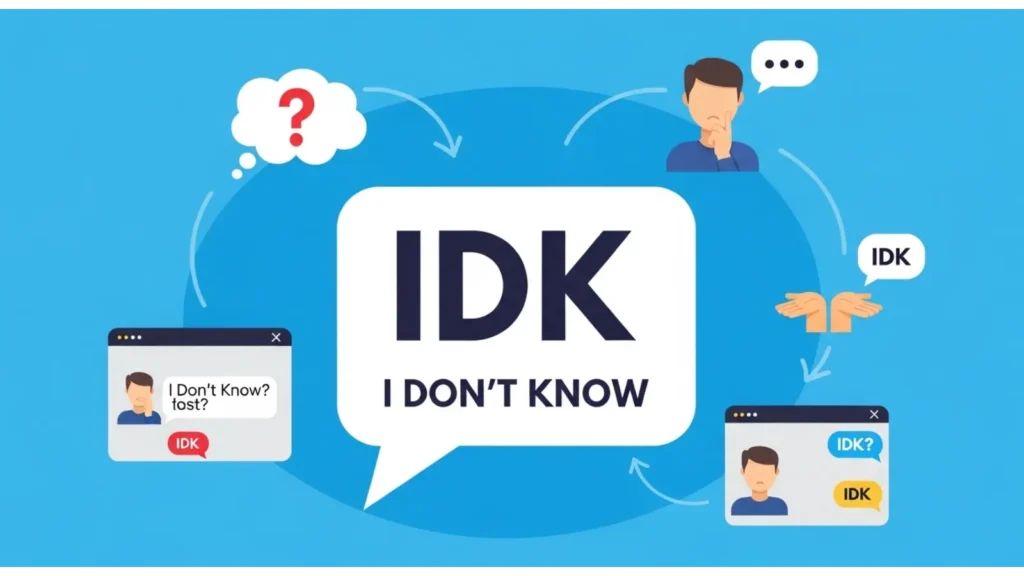
The abbreviation IDK stands for “I Don’t Know.”
People use it when they are unsure about something, do not have enough information, or simply do not know the answer.
Example situations where people use IDK include
• When someone asks a question and you are unsure about the answer.
• When you are thinking about something but have not decided yet.
• When you want to respond quickly without explaining a lot.
Because texting conversations move quickly, using IDK makes communication faster and more natural.
The Full Form of IDK
The full form of IDK is I Don’t Know.
Each letter represents a word
• I = I
• D = Don’t
• K = Know
This abbreviation became popular with the rise of online messaging and social media platforms where short replies are common.
When People Use IDK in Text Messages
People often use IDK in casual conversations with friends, family members, classmates, or coworkers in informal chats.
Here are common situations where IDK appears in texting.
When Someone Asks a Question
If someone asks something and you are unsure about the answer, IDK is a quick response.
Example
Friend: “What time does the movie start?”
You: “IDK. I will check the schedule.”
When You Are Undecided
Sometimes people use IDK when they have not made a decision yet.
Example
Friend: “Are you coming to the party tonight?”
You: “IDK. I might be busy.”
When You Want a Short Reply
In fast chats, people prefer short responses.
Example
Friend: “Why is the game not loading?”
You: “IDK. Maybe the server is down.”
Real Text Conversation Examples
Seeing real examples makes it easier to understand how IDK works in everyday texting.
Example 1
Friend: “Where did Sarah go?”
You: “IDK. She left a few minutes ago.”
Example 2
Friend: “Do we have homework today?”
You: “IDK. I forgot to ask the teacher.”
Example 3
Friend: “Should we watch a movie tonight?”
You: “IDK. What movies are out?”
Example 4
Friend: “Why is your phone so slow?”
You: “IDK. Maybe I need to restart it.”
These examples show how IDK helps keep conversations simple and natural.
Is IDK Casual or Formal
IDK is considered casual internet slang.
It is perfect for texting friends, chatting online, or messaging on social media platforms.
However, it is usually not suitable for formal communication such as
• Work emails
• School assignments
• Professional messages
• Official reports
In formal situations, writing the full phrase “I don’t know” is more appropriate.
Example comparison
Casual text
“IDK what time the meeting is.”
Formal message
“I don’t know the meeting time yet.”
Is IDK Rude or Polite
In most cases, IDK is neutral and not rude. It simply means you do not have the answer.
However, tone matters in texting. If someone asks an important question and you respond only with IDK, it may sound a little dismissive.
A better response can include extra words.
Example
Short response
“IDK.”
More polite response
“IDK yet, but I will check for you.”
Adding a few words can make your message sound friendlier.
Variations of IDK in Texting
Many similar abbreviations appear with IDK in online conversations.
IDK Yet
People use this when they expect to know the answer later.
Example
“I IDK yet. I will tell you tomorrow.”
IDK Why
Used when something confusing happens.
Example
“IDK why my phone keeps restarting.”
IDK TBH
TBH means “to be honest.” This phrase shows honesty in a response.
Example
“IDK TBH. I was not paying attention.”
IDK Maybe
Used when someone is uncertain but considering something.
Example
“IDK maybe we should leave early.”
Why IDK Became Popular Online
Text slang became popular because digital communication requires speed and convenience.
Here are a few reasons why IDK spread quickly.
Faster Typing
Typing three letters is faster than typing the full phrase.
Mobile Messaging
Smartphones encouraged shorter messages.
Social Media Culture
Platforms like chat apps and comment sections favor quick responses.
Informal Communication
Online conversations often feel relaxed and casual.
Because of these reasons, abbreviations like IDK became a normal part of internet language.
IDK on Social Media
You will see IDK on many social platforms and messaging apps such as
• Instagram comments
• Snapchat messages
• TikTok replies
• Discord chats
• WhatsApp conversations
• Gaming chats
Example social media comment
“IDK why this video is so funny but I cannot stop laughing.”
Similar Text Slang to IDK
Several other abbreviations are often used in the same types of conversations.
IDC
Means I Don’t Care.
Example
“IDC what movie we watch.”
IMO
Means In My Opinion.
Example
“IMO that game is overrated.”
IKR
Means I Know Right.
Example
“IKR. That movie ending was crazy.”
NVM
Means Never Mind.
Example
“NVM I figured it out.”
These abbreviations are part of the same internet slang culture used in texting and social media.
Should You Use IDK in Professional Messages
In professional settings, abbreviations like IDK should usually be avoided.
Instead of writing IDK, use clear and professional wording.
Example
Informal
“IDK the answer.”
Professional
“I am not sure about the answer at the moment.”
Professional communication works better when messages are clear and complete.
Tips for Using IDK Correctly
Here are simple tips to help you use IDK naturally.
• Use it in casual conversations with friends.
• Avoid using it in formal writing.
• Add extra words if you want to sound polite.
• Use it when you genuinely do not know the answer.
• Combine it with other phrases to sound more natural.
Using slang appropriately helps your messages sound friendly and natural.
Final Thoughts
The abbreviation IDK is one of the most common pieces of internet slang used in texting and online conversations. It simply means “I Don’t Know,” and people use it when they are unsure about something or do not have the answer.
Because texting culture favors speed and simplicity, short forms like IDK became extremely popular on social media and messaging apps. While it works perfectly in casual chats with friends, it is better to avoid using it in formal communication.
Understanding slang like IDK helps you communicate more naturally in modern digital conversations and makes it easier to understand online messages from others.

I’m Luna Punster, a wordplay enthusiast who loves turning ordinary phrases into pun-tastic creations. I believe laughter is the best kind of connection, and puns make it even better. Writing witty and clever lines is my favorite way to spark smiles.
Through my playful words, I aim to sprinkle joy and humor everywhere I go.