You’re scrolling through TikTok comments or reading a late-night group chat, and suddenly someone types:
“DPMO fr.”
“Bro really said DPMO 💀”
“She thought I was gonna DPMO.”
Now you pause for a second.
Wait… what does DPMO mean in text? Is it an insult? A joke? A threat? Flirting? Internet sarcasm? Something from meme culture?
That confusion is exactly why so many people search this phrase. Internet slang moves insanely fast, and sometimes one abbreviation can carry attitude, emotion, humor, and social tension all at once. Especially on TikTok, Instagram, Snapchat, and X, where short phrases become emotional shorthand for entire moods.
And honestly? DPMO is one of those slang terms that depends heavily on tone, context, and internet culture awareness. Sometimes it’s playful. Sometimes it’s aggressive. Sometimes it’s just dramatic internet exaggeration.
Let’s break it down in a way that actually makes sense.
DPMO – Quick Definition
DPMO usually means:
“Don’t Piss Me Off.”
It’s commonly used in texting, social media comments, memes, and casual online conversations to express irritation, frustration, annoyance, or dramatic emotional reaction.
But like most internet slang, the emotional meaning changes depending on how someone says it.
Sometimes DPMO can mean:
• Mild annoyance
• Playful irritation
• Fake anger between friends
• Emotional exaggeration
• Sarcastic frustration
• Internet humor
• Defensive reaction
• Emotional boundary-setting
• Mock aggression for comedic effect
Examples:
• “DPMO today, I already had a bad morning.”
• “You ate my fries again? DPMO 😭”
• “That plot twist seriously DPMO.”
• “He keeps texting her after getting ignored… DPMO bro.”
In some situations, it can even sound flirtatious or teasing when used between close friends or romantic interests.
At its core, DPMO is emotionally expressive internet shorthand for saying:
“I’m annoyed, frustrated, emotionally triggered, or reacting strongly right now.”
Origin & Background
DPMO grew out of fast-paced texting culture where people shortened emotional reactions into compact slang. Just like “IDK,” “SMH,” or “FR,” internet users naturally created abbreviations for emotional expressions that could be typed quickly during conversations.
The phrase “Don’t Piss Me Off” itself existed long before social media. People said it casually in everyday speech for decades. But online culture transformed it into a dramatic reaction phrase with meme energy.
TikTok played a massive role in spreading DPMO globally.
Short videos, reaction edits, funny arguments, relationship drama clips, and meme captions helped push the abbreviation into mainstream online language. Suddenly, people weren’t just saying they were annoyed — they were performing annoyance for humor, attention, relatability, or emotional exaggeration.
That’s a huge part of internet culture now.
Online language isn’t just communication anymore. It’s performance.
Memes turned emotional reactions into entertainment. Social media rewarded dramatic phrasing. And slang like DPMO became emotionally expressive shorthand that people instantly recognized.
What’s interesting is how quickly slang evolves online. A phrase that once sounded aggressive can become playful within months depending on how creators, influencers, and communities use it.
That’s how internet language works now. Meaning changes faster than dictionaries can keep up.
Real-Life Conversations
WhatsApp Chat
Friend 1: “You forgot my birthday again.”
Friend 2: “DPMO 😭 I literally bought your gift already.”
Here, DPMO is playful defensive frustration.
Instagram DM
“Stop posting gym pics every day bro DPMO 💀”
This sounds teasing and sarcastic, not genuinely angry.
TikTok Comments
“That ending DPMO so bad.”
This means the video emotionally frustrated or shocked the viewer.
Group Chat
“You sent the wrong screenshot.”
“BRO DPMO.”
This expresses instant irritation mixed with humor.
Relationship Text
“You liked her story?”
“DPMO right now.”
Here, the phrase carries emotional tension and jealousy.
The emotional pattern behind DPMO usage is pretty consistent:
People use it when they want others to feel their emotional reaction instantly without writing a long explanation.
It’s emotional compression.
Emotional & Psychological Meaning
This is where things get deeper.
DPMO isn’t just about anger.
Most of the time, it signals emotional overstimulation. The user feels annoyed, embarrassed, triggered, exposed, frustrated, or emotionally cornered for a moment.
Online slang often acts like emotional armor.
Instead of openly saying:
“That hurt my feelings.”
“I feel embarrassed.”
“I’m uncomfortable.”
“I’m overwhelmed.”
People turn emotions into humor, sarcasm, memes, or dramatic abbreviations.
DPMO does exactly that.
It allows someone to express emotional intensity without becoming fully vulnerable.
That’s why the phrase often feels socially sharp. It communicates emotion quickly while still protecting the speaker emotionally.
For example:
A guy gets roasted in a group chat.
Instead of admitting embarrassment, he says:
“Y’all DPMO 😭”
Everyone laughs, tension drops, and the moment becomes socially manageable.
That’s internet psychology in action.
Even in dating culture, DPMO can become emotionally layered.
Imagine someone sees their crush repost a romantic quote clearly meant for another person. They comment:
“DPMO fr.”
That small phrase can secretly contain jealousy, attraction, disappointment, insecurity, and humor all at once.
Modern slang works because it compresses complicated emotions into socially acceptable shorthand.
That’s the deeper psychology behind it.
Usage in Different Contexts
Social Media
On TikTok, Instagram, Snapchat, and X, DPMO is often dramatic and exaggerated for entertainment.
Examples:
• “This teacher really assigned homework over break… DPMO.”
• “That haircut DPMO.”
• “Why the game crash right before I won? DPMO 😭”
Social media rewards emotional reactions, so the phrase becomes expressive and theatrical.
Friends & Relationships
Among friends, DPMO is usually playful.
Example:
“You drank my soda again? DPMO.”
In relationships, though, tone matters more.
“DPMO rn” can sound joking… or emotionally serious depending on context and timing.
Work or Professional Settings
Using DPMO at work is risky.
It can sound rude, immature, or emotionally aggressive in professional communication.
Bad example:
“DPMO with these emails.”
Professional environments usually require clearer emotional language.
Casual vs Serious Tone
Tone changes everything.
Playful:
“You beat me in Mario Kart again? DPMO 😂”
Serious:
“I asked you not to do that. DPMO.”
The second example feels emotionally heavier because context removes the humor.
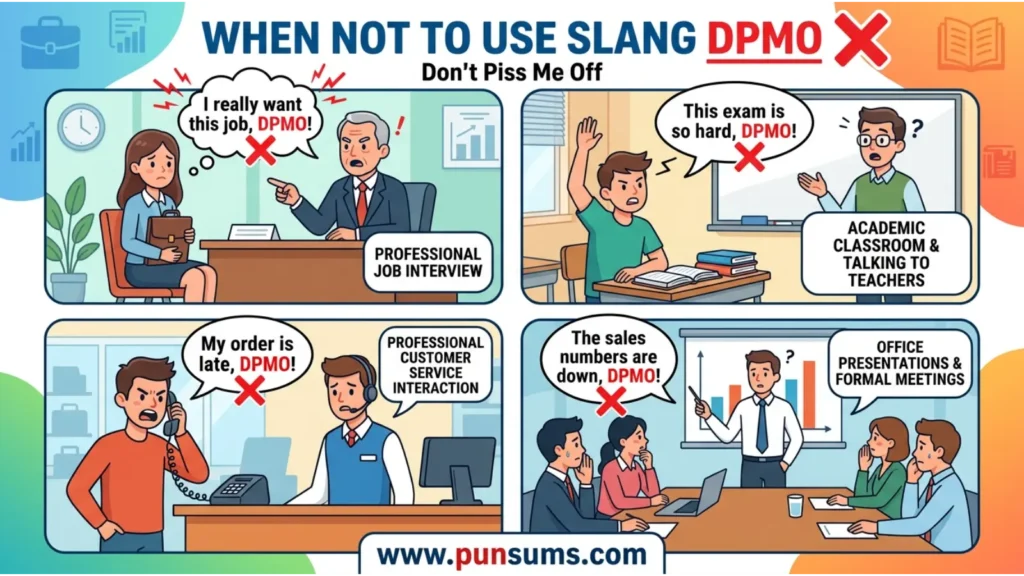
When NOT to Use Slang DPMO
There are situations where DPMO may confuse people or create tension.
Avoid using it in:
• Professional emails
• Workplace chats
• School assignments
• Serious emotional arguments
• Conversations with older relatives
• Cross-cultural discussions
• Formal communication
Some people may interpret it literally and think you’re genuinely angry.
Others may not understand internet slang at all.
And during emotional conflict, phrases like DPMO can accidentally escalate tension because sarcasm is hard to read through text.
Context protects meaning.
Common Misunderstandings
“DPMO always means real anger.”
Not true.
Most of the time, it’s exaggerated internet frustration rather than genuine rage.
“It’s always rude.”
Context matters.
Between close friends, DPMO is often playful and comedic.
“Only Gen Z uses it.”
Gen Z popularized it online, but many Millennials and internet-heavy users understand it too.
“It has one fixed meaning.”
Actually, tone completely changes interpretation.
It can sound funny, emotional, sarcastic, defensive, flirtatious, or aggressive.
“It’s dangerous slang.”
Usually, no.
It’s mostly casual internet expression unless used aggressively in conflict.
Comparison Table
| Expression | Meaning | Tone | Usage Context |
|---|---|---|---|
| DPMO | Don’t piss me off | Annoyed, dramatic | Texting, memes, reactions |
| SMH | Shaking my head | Disappointed | Social media reactions |
| FR | For real | Serious agreement | Casual conversation |
| STFU | Shut the f*** up | Aggressive or joking | Friends or arguments |
| IDC | I don’t care | Detached | Emotional distancing |
| LMFAO | Laughing hard | Humor | Memes and reactions |
The emotional difference is important.
DPMO carries more emotional tension than “SMH” but usually less aggression than “STFU.” It sits somewhere between irritation and performative internet drama.
Variations & Types
Internet slang constantly mutates into new forms.
Common DPMO variations include:
Playful Version
“Y’all really DPMO 😂”
Feels joking and socially light.
Emotional Version
“Honestly DPMO rn.”
More personal and emotionally serious.
Meme Version
“Bro existence itself DPMO.”
Absurd humor mixed with exaggeration.
Sarcastic Version
“Oh wow another Monday. DPMO.”
Dry internet sarcasm.
Exaggerated Internet Form
“DPMOOOO 😭😭”
Extra letters increase emotional intensity online.
Even tiny spelling changes affect emotional tone in digital communication.
How to Respond When Someone Uses It
Casual Replies
• “My bad 😭”
• “Relax lol.”
• “You’ll survive.”
• “Not you getting mad again.”
Funny Replies
• “Too late.”
• “Mission accomplished.”
• “Crying over fries is crazy.”
Mature Replies
• “Alright, I understand.”
• “Didn’t mean to annoy you.”
• “Let’s calm down.”
Respectful Replies
• “I hear you.”
• “Sorry about that.”
• “I’ll stop.”
Matching energy matters socially.
A playful DPMO usually needs a playful response. A serious DPMO needs emotional awareness.
That’s part of digital emotional intelligence now.
Regional & Cultural Usage
Western Culture
In the US, UK, and Canada, DPMO is mostly casual internet slang used among younger social media users.
It often appears in meme culture and reaction content.
Asian Culture
Many Asian internet users understand DPMO through TikTok, gaming culture, and global memes even if English isn’t their first language.
However, tone interpretation may differ culturally.
Middle Eastern Culture
Social media has heavily globalized English slang in Middle Eastern online spaces. Younger users often mix phrases like DPMO with Arabic slang or local humor.
Global Internet Usage
TikTok accelerated worldwide slang sharing.
Now a phrase created in one online community can spread internationally within days.
That’s why internet slang feels globally connected today.
Generational Differences
Gen Z
Gen Z uses DPMO naturally as emotional shorthand.
For them, slang is identity, humor, personality, and social performance combined.
Millennials
Millennials may understand DPMO but use it less frequently.
They often prefer older internet abbreviations like “SMH” or “IDC.”
Older Generations
Older users may interpret DPMO more literally and view it as unnecessarily aggressive.
That generational gap shows how internet language evolves culturally over time.
Is It Safe for Kids
Generally, DPMO is considered mild internet slang.
It’s not highly explicit, but parents and teachers should still understand the emotional tone behind it.
Possible concerns include:
• Sarcastic teasing
• Emotional conflict
• Online hostility
• Passive-aggressive humor
• Peer pressure communication
Most teens use it casually with friends, but context still matters.
Teaching emotional communication is more important than simply banning slang.
Understanding tone helps kids navigate digital spaces more safely.
FAQs
What does DPMO mean in texting?
DPMO usually means “Don’t Piss Me Off.” It expresses annoyance, frustration, or dramatic emotional reaction in casual texting.
Is DPMO rude?
Not always. Tone and context matter. Between friends, it’s often playful rather than aggressive.
Why is DPMO popular on TikTok?
TikTok rewards emotional reactions, humor, and dramatic expressions. DPMO fits perfectly into meme culture and reaction videos.
Can DPMO be flirtatious?
Sometimes, yes. In playful conversations, it can carry teasing emotional tension between romantic interests.
Should I use DPMO at work?
Probably not. Professional communication usually requires clearer and more respectful wording.
Do older people understand DPMO?
Some do, especially active social media users. But many older generations may find the phrase confusing or overly aggressive.
Conclusion
DPMO means “Don’t Piss Me Off,” but online, it represents much more than simple anger.
It’s internet emotion compressed into four letters.
Sometimes it’s sarcastic. Sometimes playful. Sometimes defensive. Sometimes genuinely emotional. And that’s exactly why modern slang matters so much today. Digital language isn’t just about words anymore — it’s about mood, identity, humor, social awareness, and emotional performance.
Platforms like TikTok, Instagram, Snapchat, and group chats constantly reshape how people express feelings. Slang terms like DPMO become tiny emotional signals that help users communicate frustration, attraction, embarrassment, annoyance, or humor instantly.
That’s the fascinating part of internet culture.
Even a short phrase can carry an entire emotional atmosphere.
And honestly, that’s why people keep searching slang meanings online — not just to understand the words, but to understand the people using them.
DPMO meaning in text: “Don’t Piss Me Off” — a modern internet slang phrase used to express annoyance, playful frustration, sarcasm, or emotional reaction in chats and social media.
Read More Posts:

I’m Luna Punster, a wordplay enthusiast who loves turning ordinary phrases into pun-tastic creations. I believe laughter is the best kind of connection, and puns make it even better. Writing witty and clever lines is my favorite way to spark smiles.
Through my playful words, I aim to sprinkle joy and humor everywhere I go.