You’re scrolling through TikTok comments, arguing with friends in a group chat, or watching someone roast another person online when suddenly you see this:
“Bro really said that… SYBAU.”
Or maybe:
“SYBAU before you embarrass yourself again.”
At first glance, it looks like another random internet acronym people magically understand except you. And honestly? That’s exactly why so many people search it.
Internet slang moves ridiculously fast. One week everyone’s saying “delulu,” the next week timelines are flooded with mysterious abbreviations that sound either hilarious, aggressive, sarcastic, or weirdly emotional.
SYBAU is one of those terms that instantly carries attitude. The letters are short, but the emotional energy behind them can feel intense depending on who says it, how they type it, and where it appears.
Some people use it jokingly. Others use it as a shutdown response. Sometimes it’s playful banter. Sometimes it’s straight-up internet aggression.
And that confusion is exactly what makes the phrase so interesting.
Let’s break it down in a way that actually makes sense.
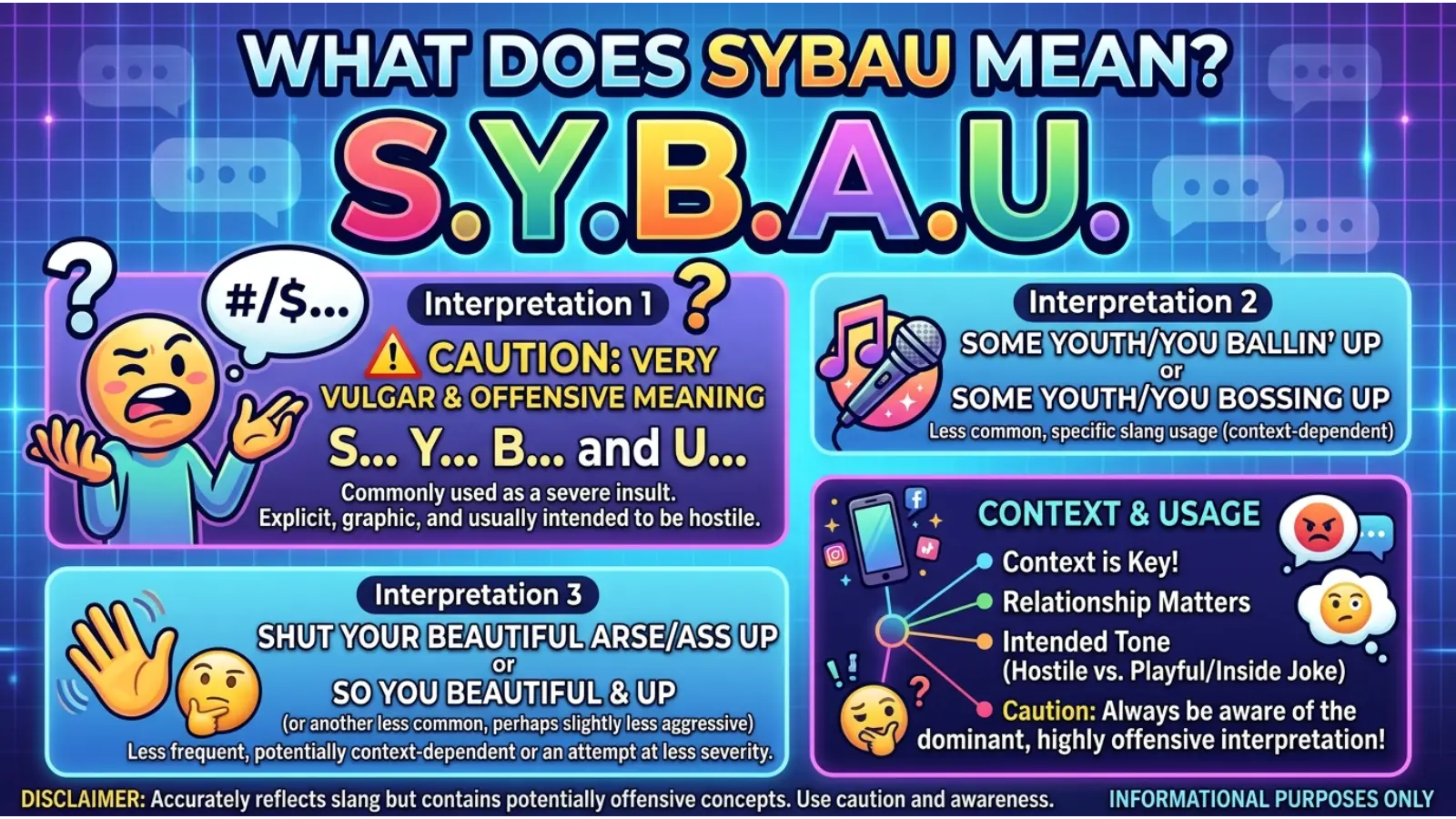
SYBAU – Quick Definition
SYBAU usually means:
“Shut Your B*tch Ass Up.”
It’s an internet slang acronym commonly used in:
- TikTok comments
- Gaming chats
- Instagram replies
- Discord servers
- Meme culture
- Group chats
- Online arguments
The phrase is often used to:
- shut someone down
- joke aggressively
- roast a friend
- react to something embarrassing
- express disbelief
- respond sarcastically
- exaggerate humor
- tease someone playfully
Here’s how it might look in conversation:
- “You still listen to that song? SYBAU.”
- “He said pineapple belongs on pizza. SYBAU.”
- “Nah that comeback was crazy 😭 SYBAU.”
But tone matters a lot.
Sometimes it’s genuinely rude. Other times it’s basically internet friendship language disguised as fake aggression. Online culture loves dramatic wording, especially among younger users.
Emotionally, SYBAU usually signals:
- frustration
- secondhand embarrassment
- playful roasting
- sarcasm
- social dominance
- exaggerated humor
At its core, SYBAU is less about the literal words and more about emotional intensity.
Origin & Background
SYBAU comes from a long tradition of internet abbreviations turning harsh phrases into fast, meme-friendly slang.
Online culture has always loved shortening expressions:
- LOL
- BRB
- IDK
- STFU
- SMH
Eventually, internet users started creating more emotionally loaded acronyms. SYBAU became popular because it feels dramatic, funny, and confrontational all at once.
The phrase exploded through:
- TikTok comment sections
- gaming communities
- reaction memes
- livestream culture
- Twitter/X arguments
- Discord conversations
TikTok especially helped spread it because the platform rewards exaggerated emotional reactions. People online constantly perform humor through overreaction.
That’s why comments like:
“SYBAU 😭”
often feel less hateful and more performative.
Meme culture changed the phrase too. What once sounded extremely aggressive became partly comedic because internet users started using it ironically with friends.
That’s the strange evolution of online language.
Words that originally sounded offensive slowly become social signals, jokes, or emotional reactions depending on context.
And honestly, internet slang changes faster than most dictionaries can keep up.
Real-Life Conversations
WhatsApp Chat
Friend 1: “I texted my ex again.”
Friend 2: “SYBAU bro 😭”
Here, it’s playful disappointment mixed with humor.
Instagram DM
Person 1: “I think I could survive a zombie apocalypse.”
Person 2: “SYBAU you cried during a spider video.”
This version feels teasing and sarcastic.
TikTok Comments
Comment: “This dance is better than the original.”
Reply: “SYBAU immediately.”
This usage is more dismissive and dramatic.
Gaming Chat
Player 1: “I carried the whole team.”
Player 2: “SYBAU you went 2-14.”
Competitive environments often use slang more aggressively.
Group Chat
Friend: “I accidentally liked her old picture from 2021.”
Everyone: “SYBAU 😭😭😭”
In this situation, the phrase expresses secondhand embarrassment.
The emotional pattern behind SYBAU is fascinating.
People use it less as literal language and more as emotional theater. It creates reaction energy. It exaggerates feelings for humor, status, and social bonding.
That’s why context completely changes the vibe.
Emotional & Psychological Meaning
SYBAU is emotionally interesting because it combines aggression with connection.
That sounds contradictory, but internet culture works that way constantly.
Sometimes friends insult each other online as a form of bonding. The fake hostility becomes part of the humor.
Using SYBAU can signal:
- confidence
- emotional intensity
- sarcasm
- social awareness
- dominance in conversation
- meme fluency
- internet humor literacy
But there’s another layer too.
A lot of online slang acts as emotional protection.
Instead of saying:
“That was awkward.”
People say:
“SYBAU 😭”
because humor softens emotional honesty.
The internet trained people to hide vulnerability behind jokes, memes, sarcasm, and exaggerated reactions.
Here’s a relatable example:
A guy in a friend group posts a gym selfie with a dramatic caption like:
“Pain changes a man.”
Immediately, his friends reply:
“SYBAU.”
On the surface, it looks mean.
But socially, it often means:
“Stop being dramatic, we know you too well.”
That’s why tone matters more than the actual words.
Among close friends, SYBAU can feel playful.
Between strangers, it can feel disrespectful or hostile.
That’s the deeper psychology behind it.
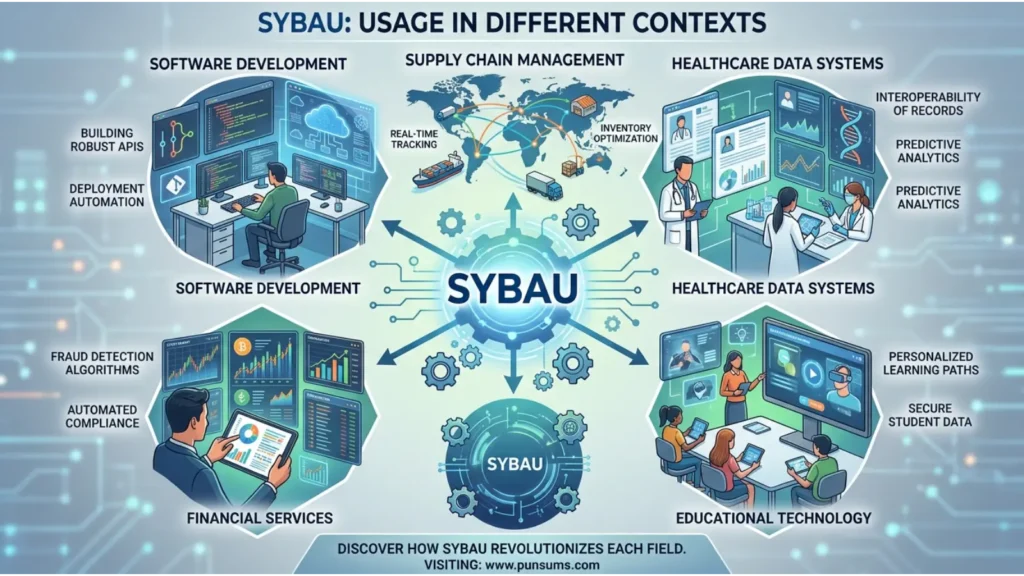
SYBAU Usage in Different Contexts
Social Media
On TikTok and Instagram, SYBAU is usually used for:
- reactions
- roasting
- sarcasm
- meme replies
- embarrassing moments
Example:
“Bro called himself an alpha male 💀 SYBAU.”
Social media exaggerates emotion for entertainment.
Friends & Relationships
Among friends, the phrase is often playful.
Example:
“You fell asleep during the movie again? SYBAU.”
But in relationships or emotional arguments, it can sound harsh.
Tone changes everything.
Work or Professional Settings
Avoid using SYBAU professionally.
Even if internet slang feels normal online, workplace communication follows different emotional rules.
Using it in emails, meetings, or professional chats can appear disrespectful or immature.
Casual vs Serious Tone
Casual tone:
“SYBAU 😂”
Usually playful.
Serious tone:
“SYBAU.”
Feels aggressive or dismissive.
Small details like punctuation, emojis, and context completely change meaning online.
When NOT to Use It
You probably shouldn’t use SYBAU in:
- professional emails
- workplace chats
- school discussions with teachers
- serious emotional conversations
- arguments already becoming toxic
- conversations with older audiences unfamiliar with slang
- cross-cultural conversations where tone may be misunderstood
Some people see the phrase as funny internet humor.
Others hear only the insult.
That’s why context matters more than the acronym itself.
Context protects meaning.
Common Misunderstandings
“It Always Means Hate”
Not necessarily.
Friends often use it jokingly without real anger.
“It’s Always Funny”
Also false.
Depending on tone, it can genuinely hurt someone’s feelings.
“It’s Just Another Meme”
It’s more than that.
SYBAU carries emotional energy and social attitude.
“Everybody Understands It”
Many people still don’t know what it means, especially outside younger internet spaces.
“It’s Safe Everywhere Online”
Definitely not.
Different communities react differently to aggressive slang.
Comparison Table
| Expression | Meaning | Tone | Usage Context |
|---|---|---|---|
| SYBAU | Shut your b*tch ass up | Aggressive, sarcastic, playful | TikTok, gaming, group chats |
| STFU | Shut the f*ck up | Direct, harsh | Arguments, jokes |
| SMH | Shaking my head | Disappointed | Casual reactions |
| LMAO | Laughing hard | Humorous | General texting |
| BFFR | Be for real | Disbelief, sarcasm | Social media debates |
| IDC | I don’t care | Detached | Casual conversations |
Emotionally, SYBAU feels more dramatic and socially charged than many internet acronyms. It carries stronger reaction energy.
Variations & Types
Internet slang constantly mutates into new forms.
Some SYBAU variations include:
- “sybau 😭”
- “SYBAUUU”
- “sybau bro”
- “nah sybau”
- “pls sybau”
- “LMFAO SYBAU”
Each version changes tone slightly.
Adding emojis softens aggression.
Stretching the letters makes it feel more dramatic or comedic.
Adding “bro” often makes it friendlier.
Internet users creatively remix slang to match emotional intensity.
That flexibility is part of why slang spreads so fast online.
How to Respond When Someone Uses It
Casual Replies
- “My bad 😭”
- “You’re not wrong.”
- “Okay okay chill.”
Funny Replies
- “I’ll respectfully ignore that.”
- “The hate is motivating me.”
- “Jealousy detected.”
Mature Replies
- “Relax, it was a joke.”
- “No need to get aggressive.”
- “Let’s keep it respectful.”
Respectful Replies
- “Fair enough.”
- “I understand your point.”
- “Didn’t mean to annoy you.”
Matching emotional energy matters socially.
Overreacting can escalate things. Underreacting can sometimes diffuse tension instantly.
Regional & Cultural Usage
Western Culture
In Western internet spaces, SYBAU is mostly meme-based humor mixed with sarcasm and playful aggression.
TikTok culture normalized exaggerated reactions.
Asian Culture
Many Asian social media users understand the term through global meme culture, though usage can vary depending on language familiarity and online exposure.
Middle Eastern Culture
Younger internet users often recognize SYBAU from gaming culture, TikTok, and English-speaking meme communities.
Global Internet Usage
Internet slang spreads globally faster than ever before.
One viral TikTok can introduce millions of users to a phrase overnight.
But cultural interpretation still changes meaning.
Some cultures see aggressive humor as normal friendship behavior.
Others view it as disrespectful immediately.
Generational Differences
Gen Z
Gen Z uses SYBAU most naturally.
For many younger users, ironic aggression is part of online humor culture.
Millennials
Millennials may understand it but use it less frequently.
They often prefer older slang formats like “STFU” or “SMH.”
Older Generations
Older users may find the phrase confusing, rude, or unnecessarily aggressive.
That generational gap reveals something important:
Language reflects identity.
Internet slang is not just communication anymore. It’s social belonging.
Is It Safe for Kids
SYBAU sits in a gray area.
On one hand:
- it’s common online
- often used jokingly
- part of meme culture
On the other hand:
- it includes insulting language
- can encourage toxic communication
- may normalize aggressive humor
- could hurt sensitive users emotionally
Parents and teens should understand the emotional tone behind slang instead of only memorizing definitions.
Not every viral phrase is harmless in every situation.
Awareness matters.
FAQs
What does SYBAU mean in texting?
SYBAU usually means “Shut Your B*tch Ass Up.” It’s often used jokingly, sarcastically, or aggressively online.
Is SYBAU rude?
It can be. Tone and context decide whether it feels playful or genuinely disrespectful.
Why do people say SYBAU on TikTok?
TikTok culture loves exaggerated reactions, sarcasm, and dramatic humor, which made the phrase popular.
Is SYBAU used between friends?
Yes. Many friends use it jokingly during playful roasting or group chat banter.
Can SYBAU be used professionally?
No. It’s inappropriate for workplace or formal communication.
Which generation uses SYBAU the most?
Gen Z uses it most commonly, especially in meme-heavy social media spaces.
Conclusion
SYBAU means “Shut Your B*tch Ass Up,” but the phrase represents something much bigger than its literal definition.
It reflects how modern internet culture communicates emotion through humor, sarcasm, exaggeration, and social performance.
Sometimes it’s playful teasing.
Sometimes it’s emotional defense.
Sometimes it’s internet comedy pretending to be aggression.
That’s why understanding slang today requires more than knowing vocabulary. You also have to understand tone, relationships, platform culture, and emotional intent.
Online language keeps evolving because people keep evolving emotionally online too.
And honestly, that’s what makes internet slang so fascinating. A few letters like SYBAU can carry humor, embarrassment, confidence, sarcasm, tension, and friendship all at once.
Read More Posts:

I’m Luna Punster, a wordplay enthusiast who loves turning ordinary phrases into pun-tastic creations. I believe laughter is the best kind of connection, and puns make it even better. Writing witty and clever lines is my favorite way to spark smiles.
Through my playful words, I aim to sprinkle joy and humor everywhere I go.